ESP32 Compressor Uses Pressure Feedback for Automatic Inflation and GPS Tracking
An ESP32, analogue pressure sensor and 12V compressor form a portable inflator with automatic shut-off, live monitoring and GPS location data.
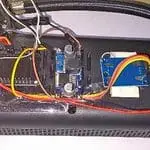
A portable compressor becomes more useful when it can stop at a set pressure and report what it is doing. This project combines a 12V DC compressor, an ESP32 and an analogue pressure sensor to automate inflation, while a GPS module adds location data and a web dashboard presents live readings and recorded measurements.

The control idea is straightforward: the ESP32 reads pressure, compares it with programmed limits and switches the compressor on or off through a MOSFET module. That makes the pressure thresholds the heart of the design. The GPS feature adds tracking, but it does not replace the sensor feedback that governs inflation.

Two power paths from one battery
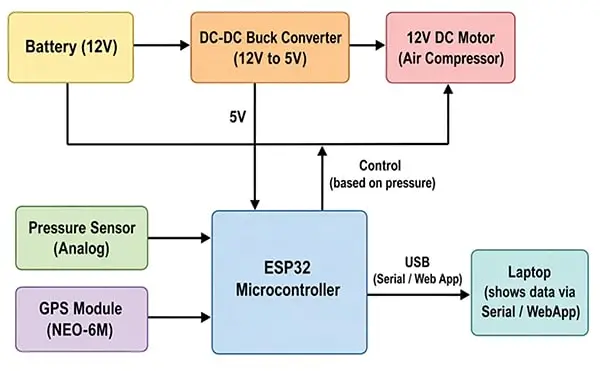
A rechargeable 12V battery supplies the system. One path feeds the compressor through a MOSFET trigger switch module; a second passes through an LM2596 DC-DC buck converter set to 5V for the ESP32, pressure sensor and GPS module. An SPST switch controls power to the control circuit.

Keeping the motor and electronics on separate supply paths suits their different needs: the compressor draws from the battery at 12V, while the lower voltage rail serves the controller and sensors. The MOSFET module is specified as a 15A, 400W drive module. Those ratings alone do not establish compatibility with every compressor, however. The module, wiring and supply need to accommodate the motor’s running current and its higher startup current.

The listed parts include an ESP32 NodeMCU-32S, an MPXH6115A pressure sensor or similar, a u-blox NEO-6M or NEO-7M GPS module, the LM2596 converter and a 12V mini compressor. The bill of materials gives ₹400 for the ESP32 board and ₹400 for the GPS module, with a stated total of ₹3200. It lists the pressure sensor at ₹2000 and includes ₹400 for miscellaneous parts. Battery and switch are included in the component list, though individual prices for them are not separately shown.

Pressure feedback sets the motor cycle
The MPXH6115A produces an analogue voltage related to pressure. Its output, Vout on pin 4, connects to GPIO32, an ESP32 analogue input. The controller samples that signal and compares the interpreted pressure with lower and upper limits set in software.
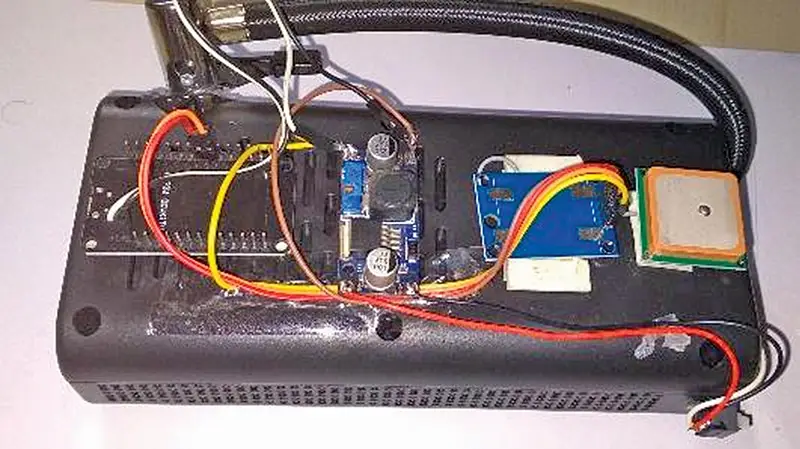
When pressure falls below the lower limit, GPIO18 drives the MOSFET module and starts the compressor. Once the upper limit is reached, the ESP32 turns the module off. Repeating this control cycle allows the system to maintain pressure within a band instead of leaving the motor running continuously. The gap between the thresholds is a practical design choice: a band gives the controller room to respond without switching at every small fluctuation in the reading.
The sensor’s range needs particular attention before choosing a target. The MPXH6115A is specified in the project note for roughly 15–115 kPa absolute pressure. That range may not suit an application targeting 35 PSI, so a sensor with a suitable pressure range is needed for such a target. The controller can only make a meaningful shut-off decision if the sensor covers the intended operating pressure and its signal is interpreted appropriately.

GPS and dashboard functions
The NEO-6M communicates with the ESP32 over UART. Its TXD and RXD connections go to GPIO16 (RX2) and GPIO17 (TX2), respectively. The module supplies latitude, longitude, altitude and time data. Pressure readings and GPS information can be viewed through the serial monitor for monitoring and data logging.

The project also describes a web dashboard for live pressure graphs, recorded data, pressure settings and device status. This gives the operator a way to see the control loop’s behaviour over time, as well as the current reading. The GPS data can also support a programmed location rule that enables or disables the compressor in a predefined area. That function depends on the software and location data; the description does not specify the boundary method or how the system behaves when GPS reception is unavailable.

The ESP32, described as running at up to 240MHz, handles the analogue input, motor-control output, serial GPS link and interface functions. This division keeps the main control decisions local to the device: pressure measurement and compressor switching do not depend on the dashboard being available.
Build considerations
Switching a motor can produce voltage transients, so the project calls for a suitable suppression device across the compressor motor. The switching hardware and connections also need to be selected for the motor’s startup and operating current. These details matter to both reliable control and component selection, particularly when pairing a compact battery with a motor load.
The project is presented as a medium-complexity build, with a stated completion time of six hours and a parts total of ₹3200. Its useful engineering lesson is the integration of analogue sensing, threshold control, motor switching, serial communications and a monitoring interface in one portable system. Before using it for a particular tyre or other inflatable item, the pressure sensor range and programmed limits must match that application. The result is a compact platform for controlled inflation whose most important next design check is confirming the sensing and power hardware suit the intended load and pressure.
 Choosing Single, Double, Welded Flap and Repair Keder for Fabrication
 MIG Transfer Modes: Choosing Between Short Circuit, Spray and Pulse
 CNC Steel Machining: Material Grades, Processes and Quality Factors