Diodes AHC1724Q and AHC1725Q Hall Sensors Target EV Charger Current Measurement
Diodes’ AHC1724Q and AHC1725Q combine galvanic isolation, a 1.2 mΩ current path and 120 kHz bandwidth for charger and industrial designs.
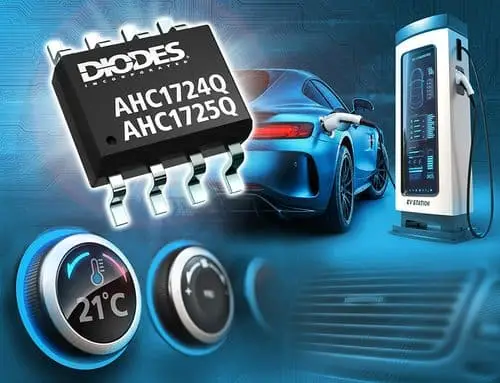
Current sensing in an EV charger has to balance measurement accuracy, heat, board area and electrical isolation. Diodes Incorporated’s AHC1724Q and AHC1725Q Hall effect sensors address those constraints with a 1.2 milliohm copper current path, measurement up to ±50A and an isolated sensing circuit. The company positions the automotive-compliant devices for onboard chargers and charging stations, as well as industrial equipment.

Low resistance limits sensing-path losses
Each sensor routes the measured current through an integrated copper conductor and detects its magnetic field with a Hall element. Because the current path has 1.2 milliohms of resistance, it dissipates less power as heat than a higher-resistance path carrying the same current. That can ease thermal demands around the sensor, though the total heat in a charger still depends on operating current, duty cycle, layout and cooling.

The devices measure AC and DC current up to ±50A. Diodes lists versions for unidirectional or bidirectional current measurement, giving designers a choice that depends on how current flows in the target circuit. Bidirectional sensing is relevant where current can reverse; a one-direction device may fit circuits whose measured current has a fixed polarity. The available product information does not specify the part-by-part mapping of those options, so selection requires checking the device documentation.

The low-resistance conductor also makes the measurement approach distinct from a conventional shunt arrangement: the sensor detects the field produced by current in the conductor rather than deriving current from a voltage drop across a sensing resistor. That can reduce the sensing element’s contribution to conduction loss, while placing accuracy and response requirements on the Hall sensing chain and its signal conditioning.

Isolation and voltage limits shape integration
The current-carrying path is electrically isolated from the sensing circuitry. Diodes says this arrangement supports measurement on the high-voltage side without additional isolation circuits. The devices have a maximum working voltage of 420V DC and meet the basic insulation requirements of UL 62368-1. These ratings define important boundaries for system design; they do not, by themselves, establish suitability for every charger voltage, insulation coordination scheme or end-product safety design.
For engineers integrating a sensor into an onboard charger or charging station, the isolation architecture can reduce the number of separate components needed for the measurement interface. The practical benefit depends on the complete system: designers still need to account for the voltage present across the barrier, PCB spacing, transient conditions, thermal environment and the applicable requirements for the finished equipment.

The compact package is also intended to help reduce PCB area. That matters where charger designs must fit power conversion, control, protection and communication circuits into constrained enclosures. A smaller sensor can free layout space, but board-level thermal management and routing still determine whether the surrounding power stage can operate within its limits.

Fast response for control and protection
Diodes specifies a 120kHz bandwidth, a 4.0µs response time and a 2.0µs propagation delay. Those figures describe different aspects of dynamic behavior: bandwidth indicates the range of signal frequencies the device can track, while response time and propagation delay characterize how quickly its output reacts to a change in input current. They are relevant when the current measurement feeds switching control or overcurrent fault protection, where delayed or attenuated signals can affect system behavior.
A low-offset, chopper-stabilised architecture is intended to reduce small measurement errors. The output voltage varies in proportion to the supply voltage, a characteristic designers need to consider when connecting the sensor to an analogue-to-digital converter or controller. The reported specifications give a basis for comparing the parts with a system’s sampling rate, filtering and protection response needs; the final measurement performance will also depend on circuit implementation.
Beyond vehicle charging
The manufacturer also cites power supplies, load detection and management, overcurrent fault protection and HVAC systems as possible applications, including equipment exposed to harsh conditions and high temperatures. Across these uses, the same combination is the central design proposition: a low-resistance current route, isolated Hall measurement and a response fast enough for changing electrical loads.
Diodes Incorporated has not provided temperature limits, package dimensions, measurement error figures or pricing in the available product details. Engineers assessing the AHC1724Q and AHC1725Q will need those particulars, along with the exact directional configuration and full electrical ratings, to determine fit for a design. The stated 420V DC working-voltage limit and UL 62368-1 basic insulation qualification are useful starting points, while the current range, bandwidth and response figures help establish whether the sensing performance matches the charger or industrial control task.
 Houston Engineering Team Builds a Welcoming Golf Tournament at East River 9
 MIG Transfer Modes: Choosing Between Short Circuit, Spray and Pulse
 TI India’s 40-Year Engineering Hub: From Chip Design to Complete Products