IRis ESP32 Remote Learns and Replays Infrared Codes
IRis captures and replays common IR protocols with an ESP32, OLED and five buttons, while AC state commands and battery monitoring remain limited.
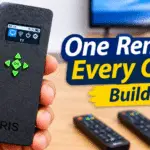
IRis turns an ESP32 development board into a handheld infrared remote that can capture commands from existing controllers and replay them later. Built by maker Nicolas Ruiz Neiman, it combines onboard learning with support for stored remote definitions, giving the project two ways to handle devices whose buttons use different infrared codes.

The distinction between decoded commands and raw captures is central to how IRis works. Its firmware recognises NEC, Samsung, Sony SIRC, RC5 and JVC signals, recording protocol, address and command information for those formats. When a signal uses another protocol, the remote can retain the capture in raw form for later replay. That gives the design some reach beyond its listed decoders, though replaying a capture does not mean the firmware has interpreted the command’s meaning.

Capture, store and replay
An ESP32-WROOM-32 development board runs the firmware and handles the user interface. A TSOP38238 receiver detects incoming infrared transmissions; two TSAL6200 infrared LEDs send stored signals back out. Five tactile buttons provide input, and a 1.3-inch OLED shows the interface. The display can be an SSD1306 or an SH1106 module.
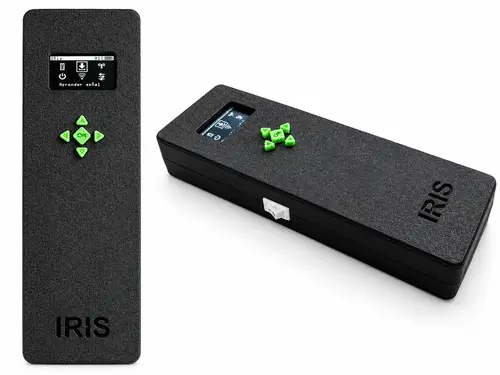
For users with a prepared collection of remote definitions, IRis can also load files in the .ir format used by the Flipper-IRDB collection. Those files are read from a microSD card, which is optional. This route differs from teaching the remote a signal directly: a card lets users bring in existing definitions, while the receiver captures commands from a physical controller.
The firmware is written in C++17 and built with PlatformIO using the Arduino-ESP32 framework. Its decoded records include the protocol, address and command fields, which makes them more structured than a raw timing capture. The project’s Be Gone mode sends power-off codes for devices in a selected category. That feature depends on the relevant codes being available to the remote; the project description does not establish that every device in a category will respond to the same command.

Transmitter and power design
The transmitting LEDs are driven by an NPN 2N2222 transistor. This separates the LED drive path from direct GPIO drive, while the ESP32 controls the transistor. The reported build uses an 18650 lithium-ion cell, an XL6009 boost converter set to 5V, and a USB-C charging module with protection. The circuit is assembled on perfboard and housed in a 3D-printed PLA enclosure.
Neiman reports that the assembled unit controlled a TV from approximately two metres using both infrared LEDs. The estimated current was 34mA per LED, calculated from circuit values rather than measured during operation. That figure should therefore be read as a design estimate, not a measured transmitter result. The reported range is a single practical example, not a guarantee for different receivers, room conditions or target devices.

The project’s hardware and enclosure files are available in its repository, including printer-friendly case files that can be modified. Pin assignments are collected in include/board_pins.h, which gives developers a defined place to adjust the GPIO configuration when adapting the firmware to another ESP32-compatible development board.

Limits to account for
There are meaningful gaps between protocol support in firmware and validation on the assembled hardware. Although the code includes several protocol decoders, the maker reports testing the hardware only with NEC remotes. The project has about 210 tests, but these run on a PC and do not confirm that every function behaves correctly on the physical device. Users should treat broad hardware compatibility as unverified.
Air-conditioner controllers are a particular challenge. Many transmit complete state commands that describe multiple settings together; IRis does not support decoding that kind of full-state command. The design also sends one frame per keypress rather than repeating frames. Some equipment may expect repeated transmissions, so a captured code that looks correct may still not operate every target as intended.
The battery indicator estimates remaining capacity rather than measuring it directly. Charging also comes with a practical limitation: the remote should be switched off while charging because the charging module does not provide a way to transmit power. That affects how the unit can be used at a desk or during setup, even though the hardware includes USB-C charging.
Firmware is released under the GPL-3.0 license. The combination of editable pin definitions, replaceable enclosure files, direct capture and microSD imports makes IRis a useful base for experimentation with infrared control. Its clearest next engineering questions are how reliably raw captures replay across devices, how the supported protocols perform on hardware beyond NEC, and whether future revisions can address stateful air-conditioner commands and repeated-frame transmission.
 Choosing Single, Double, Welded Flap and Repair Keder for Fabrication
 Houston Engineering Team Builds a Welcoming Golf Tournament at East River 9
 MIG Transfer Modes: Choosing Between Short Circuit, Spray and Pulse