MIT Method Trains Climate AI Emulators with One Earth System Simulation
MIT researchers use optimized synthetic scenarios to help climate emulators predict unfamiliar emissions paths from one Earth system simulation.
Climate emulators can produce climate projections far faster than large Earth System Models (ESMs), but their predictions tend to weaken when emissions follow paths outside their training data. Researchers at the Massachusetts Institute of Technology (MIT) describe a way to train an emulator with optimized synthetic climate scenarios, using data from one ESM simulation instead of several. The approach is intended to improve predictions for unfamiliar emissions patterns while reducing the costly simulation work needed to prepare training data.

Why emulator training data matters
An ESM represents physical processes across the Earth’s climate system and calculates how variables such as temperature, precipitation and sea level change under different greenhouse gas emissions. Running one scenario on a supercomputer can take several months, according to the account of the research. That expense limits how many scenarios researchers can simulate and use to train faster AI models.

Climate emulators learn to approximate the outputs of these larger models. Once trained, they can estimate climate outcomes at much lower computational cost. Their usefulness, however, depends on the range and quality of their examples: an emulator trained on a narrow set of emissions trajectories may not reliably extrapolate when the mix or timing of emissions changes.
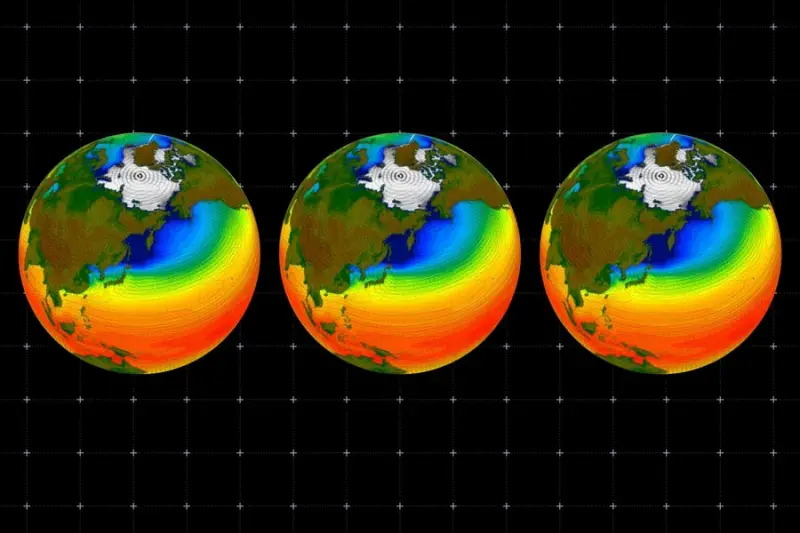
The conventional training approach described by the researchers uses six to eight plausible emissions scenarios. These scenarios generally follow smooth, realistic trends. That makes them useful examples of expected pathways, but it can leave the emulator poorly prepared for conditions that depart substantially from those examples. A model may reproduce familiar patterns well and still struggle when asked to predict a less familiar combination of emissions changes.

Creating scenarios to expose prediction errors
MIT’s method uses an optimization algorithm to generate artificial climate scenarios designed to improve a particular emulator’s predictive ability. It begins with a randomly selected scenario produced by a lower-order climate model. The emulator then predicts the climate response, and the algorithm compares that prediction with the lower-order model’s result to estimate the error.

The algorithm uses that error to adjust the synthetic training scenarios. In effect, the training data is tuned to challenge the emulator where its current predictions diverge from the comparison model. The process can supply varied training examples from a single ESM simulation, according to the researchers’ description, instead of requiring multiple expensive simulations for separate emissions pathways.
The distinction is in how the examples are constructed. Standard datasets tend to track smooth emissions trends. The synthetic scenarios can include rapid fluctuations in carbon dioxide and methane emissions. Those sharper changes are intended to make the emulator learn how the climate system responds across a broader range of inputs, rather than fitting only the gradual trajectories represented in conventional training data.

Testing beyond familiar emissions paths
The researchers report that the trained emulator could predict scenarios absent from its training dataset. One example combines reduced emissions of one pollutant with increased emissions of another under a regional pollution control policy. This type of mixed pathway is a useful test of generalization: the model must account for different gases moving in opposite directions instead of simply extending a familiar trend.

For climate analysts, that flexibility could make emulators more useful when exploring conditions that are difficult to anticipate in advance. A model that handles a wider range of input combinations can support faster comparisons across possible emissions paths, while reserving the most expensive ESM runs for cases where detailed simulation is needed.
There is still a modeling boundary to keep in view. Synthetic examples are generated through an algorithm and compared with a lower-order climate model; their value depends on how well that process represents the responses an ESM would produce. The reported result concerns an emulator’s ability to predict cases outside its training set, and the account provides no numerical accuracy figures, named ESM, or detailed test conditions. The work therefore points to a training strategy, rather than establishing a universal performance gain across climate models.
The practical advance is the possibility of getting more varied training coverage from a smaller number of expensive simulations. If the approach holds across additional models and evaluation cases, climate teams could spend less time generating separate training runs and gain a more adaptable emulator for testing emissions scenarios that do not follow the usual smooth path.
 Choosing Single, Double, Welded Flap and Repair Keder for Fabrication
 Houston Engineering Team Builds a Welcoming Golf Tournament at East River 9
 MIG Transfer Modes: Choosing Between Short Circuit, Spray and Pulse