QuantumScape Osprey Cells Target Five-Minute Charging and 1,000-Cycle Life
QuantumScape reports five-minute charging and about 80% capacity retention after 1,000 cycles in Osprey lab cells; both results need scale-up validation.

QuantumScape’s Osprey platform pairs a reported five-minute charge from 10% to 80% with roughly 80% capacity retention after 1,000 cycles. The results point to a potentially useful combination of fast charging and cycle life, but they come from small laboratory cells. They don’t yet show how a complete vehicle battery will perform.

What the cycle test measured
QuantumScape reports that its two-layer unit cells retained about 80% of their capacity after 1,000 complete charge and discharge cycles. The company ran that test at a 1C charge and discharge rate, with 100% depth of discharge, at room temperature and one atmosphere of applied pressure. Cathode loading exceeded 5 mAh/cm².

Those conditions matter when comparing battery results. A 1C rate relates current to the cell’s capacity, while a 100% depth of discharge means the test used the full stated capacity range in each cycle. The pressure, temperature, cell construction and cathode loading also define the conditions under which the reported retention was measured. Different cell designs or operating conditions may produce different results.
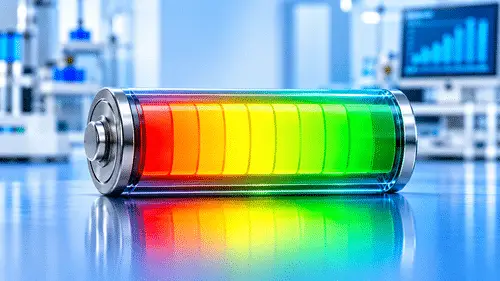
The five-minute charge figure describes a separate test result: charging from 10% to 80% capacity. QuantumScape characterises that configuration as power-optimised. The company has not shown that the same cell configuration also delivers the platform’s projected energy density, so the two performance figures shouldn’t be treated as simultaneous specifications for one battery.

Cell design and cold operation
Osprey combines QuantumScape’s ceramic separator and anode-free lithium-metal approach with a solid cathode made from sulfides. In an anode-free design, lithium metal forms during charging rather than being stored in a conventional anode material from the outset. The separator and electrode interfaces therefore have to support lithium movement and deposition through repeated cycling. The reported test results offer an early view of how this cell architecture performs under controlled conditions; they don’t establish how it will behave in larger formats or in a vehicle pack.

QuantumScape also says the cells operated at temperatures down to -20°C. The available information doesn’t specify the charge rate or cycle-life performance at that temperature, so the low-temperature result should be read as a demonstrated operating point, not as evidence that the five-minute charging result or the 1,000-cycle retention figure applies there too.
For an energy-optimised battery using high-loading cathodes, QuantumScape projects an energy density of around 1,100 Wh/l. That figure is a projection, not a measurement from the fast-charging cell. Keeping the energy-optimised and power-optimised configurations distinct is key to assessing the design: improving charge power and packing more energy into a given volume can call for different cell choices.

A development platform, not a production battery
QuantumScape describes Osprey as a platform for licensing and co-development with battery manufacturers and carmakers, rather than a product ready for purchase. The company says cells based on its QSE platform are shipping to customers, while Osprey represents its longer-term work on all-solid-state cells. That distinction signals a development path, not commercial availability of Osprey cells.

Moving from two-layer test cells to larger cell formats will require engineering work on cell design and manufacturing. Higher-throughput production processes are also still needed, according to QuantumScape. Those steps will determine whether the laboratory performance can be carried into cells that can be made consistently at commercial scale.
The company cautions that early test results may not carry over to commercial cell formats or production volumes. Independent confirmation using commercial-scale cells and vehicle battery packs has not been reported, and QuantumScape has given no Osprey production date or pricing details.
For engineers assessing the platform, the useful near-term reference points are the test conditions: two-layer cells, 1C cycling, full depth of discharge, room temperature and one atmosphere of pressure for the 1,000-cycle result. The next meaningful evidence will be performance data from larger cells and manufacturing processes that can reproduce those results at higher throughput.
 Choosing Single, Double, Welded Flap and Repair Keder for Fabrication
 Houston Engineering Team Builds a Welcoming Golf Tournament at East River 9
 MIG Transfer Modes: Choosing Between Short Circuit, Spray and Pulse