Keysight Expands Automated Test Power to 1500 V and 90 kW
Keysight’s new test systems span 10 V to 1500 V, with regenerative loads and scalable configurations rated up to 90 kW.
Automated test racks are being asked to cover a wider range of power levels without consuming more floor space. Keysight Technologies has introduced a high power test product family that combines regenerative power supplies, electronic loads and DC power supplies, with models spanning 10 V to 1500 V and power ratings reaching 12 kW. For engineers building test systems for batteries, converters, avionics equipment and charging stations, the main change is the breadth of voltage options and the amount of test capacity available per rack unit.

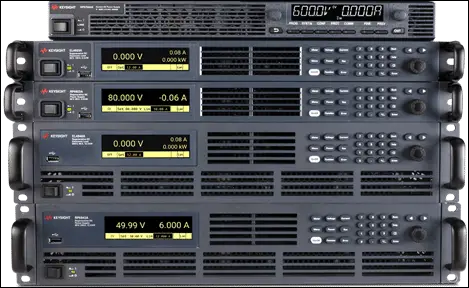
The voltage range addresses several distinct test needs. The 10 V models can provide source current up to 1020 A, a combination intended for power stage characterisation, DC bias and burn-in testing. At the other end, 1500 V models are aimed at high voltage battery modules, converters and chargers. Between them, 32 V models serve nominal 24 V and 28 V architectures, while 300 V units target nominal 270 VDC aerospace equipment.

That spread matters because voltage and current requirements shape the test equipment, cabling and system layout. A high current, low voltage test has different demands from a high voltage battery test; a flexible product family can let integrators assemble equipment around the device under test rather than force every application into one supply range. The stated model voltages provide useful selection points, although the available information does not specify output accuracy, transient response, ripple, measurement resolution or operating limits across each model’s range. Those details will matter when matching a unit to a particular test procedure.

More test power in less rack space
Keysight’s stated density figures are central to the launch. Regenerative power supplies and electronic loads deliver 6 kW per 1U or 12 kW per 2U. The new DC supply family reaches 12 kW per 2U, with some models rated at 7.5 kW per 1U. The company says this allows two to three times more channels in the same rack space than before.

For a test engineering team, higher power density can change the physical design of an automated test system. More channels in a fixed rack can reduce the number of cabinets or leave room for switching, measurement and control hardware. It can also help scale a system as test demand grows, provided the facility’s electrical service, cooling and rack infrastructure can support the added load. The stated density figures describe equipment capacity; they don’t by themselves establish the cooling or input power requirements of a complete installation.
Supported configurations can automatically parallel up to 12 power supply units, with system power scalability reaching 90 kW. Paralleling offers a route to greater output capacity while retaining a modular arrangement. Integrators will still need to confirm how a chosen configuration handles current sharing, protection and system control, since those implementation details aren’t specified in the available product information.

Regeneration changes the load side
The family also includes regenerative operation for tests that would otherwise consume substantial electrical energy in electronic loads. A regenerative load returns energy rather than dissipating all of it as heat. That can reduce the energy converted to waste heat during suitable test cycles, though the practical benefit depends on the test profile and the system’s operating conditions. The product information does not state an energy recovery efficiency or define the conditions under which regeneration is available.

This capability is relevant when testing equipment that repeatedly absorbs power, including battery systems and power conversion hardware. In those applications, the load is an active part of the test setup: it must reproduce the required electrical conditions while handling the energy flowing back from the device under test. Regeneration can therefore affect both load selection and the facility-level design of a test cell.
Software and application fit
The product portfolio includes PathWave Advanced Power Control and Analysis software, along with PathWave Advanced Battery Test and Emulation software. These tools are intended to support test configuration and analysis, and the battery package adds a software option for battery testing and emulation. Keysight also lists compatibility with nominal 24 V and 28 V power architectures and support for nominal 270 VDC systems.
For teams evaluating the family, the practical questions are now configuration-specific: which voltage model fits the device under test, how many channels the rack must support, and whether the stated power density and regenerative operation suit the test cycle. The headline range reaches 1500 V, while modular paralleling scales supported systems to 90 kW. Model-level electrical performance, interfaces and installation requirements will determine how readily those capabilities translate into a working test rack.
 Houston Engineering Team Builds a Welcoming Golf Tournament at East River 9
 MIG Transfer Modes: Choosing Between Short Circuit, Spray and Pulse
 CNC Steel Machining: Material Grades, Processes and Quality Factors