Pickering 41-621 and 43-621 Add Four Waveform Channels to One PXI Slot
Pickering’s PXI and PXIe generators combine four synchronized outputs in one 3U slot, targeting compact avionics and legacy ATE test systems.
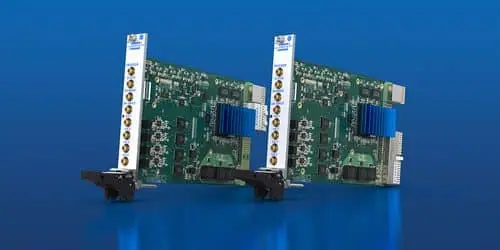
Four synchronized waveform outputs in one 3U PXI/PXIe slot are the central change in Pickering Interfaces’ 41-621 and 43-621 arbitrary waveform generators. For test engineers simulating several sensor signals at once, that channel density could reduce the number of instrument slots needed and simplify compact automated test equipment (ATE) configurations. The appeal is easy to understand: a test rack has finite space, and every slot assigned to one function limits what else can fit. Whether fewer slots also mean a simpler system depends on the test’s signal needs and the rest of the rack.

More outputs per slot
Pickering introduced the 41-621 for PXI and the 43-621 for PXIe. Each family is available in two-channel and four-channel versions, with the four-channel model producing four separate electrical outputs while occupying one 3U-sized slot. That arrangement gives designers a choice between matching channel count to the test and reserving capacity for later changes. The company positions the instruments for avionics functional testing, full authority digital engine control (FADEC) testing, multi-channel sensor simulation and upgrades to legacy ATE.

The practical benefit depends on how a test rack is built. Where a test sequence needs multiple independent stimuli, combining four outputs in one slot may leave space for other instruments or reduce the number of chassis slots assigned to waveform generation. That can matter in a fixed chassis, where adding another instrument may require a larger enclosure or changes to the rack plan. Pickering says its four-channel PXIe model provides twice as many outputs in the same space as two-channel products currently on the market. That comparison is the manufacturer’s claim; the supplied product information doesn't specify the competing models or the conditions used for the comparison.
Pickering also estimates that the four-channel version costs approximately 40% less per signal output than competing solutions. That figure is a company estimate, and no purchase price or comparison methodology is provided. For system planners, the relevant cost will still depend on the complete setup, including the chosen PXI or PXIe platform and the number of channels required. A lower cost per output may be useful when many signals are needed, but the figure alone doesn't establish the cost of a working test system.

Coordinated signal generation
The generators can produce amplitude modulation (AM), frequency modulation (FM), frequency-shift keying (FSK), phase-shift keying (PSK) and pulse-width modulation (PWM). These formats let engineers apply different kinds of electrical stimulus when checking how electronic devices and sensors respond. A test may need to reproduce changing inputs, compare a device’s response under different signal conditions, or present more than one stimulus during the same sequence. The product description also highlights coordinated channel timing, allowing multiple outputs to operate together for tests that require signals to arrive at defined times.

That coordination matters when a test represents more than one changing input. A multi-channel sensor simulation, for example, can require related signals to be presented as a group so that the device under test sees a consistent stimulus. Timing relationships can shape what the test reveals: if inputs that should be related arrive at the wrong time, the resulting response may reflect the test setup as much as the device. Putting several outputs into one instrument slot may also help keep the physical test configuration compact. The available details don't give waveform limits, output ranges, timing resolution or channel-to-channel synchronization specifications, so those parameters need to be checked against the intended test plan.
Pickering Product Line Manager Tom Sarfi said engineers need to reproduce increasingly complex signals while keeping test systems compact, affordable and supportable. He described the added channels as a way to reduce system footprint and cost while retaining stimulus flexibility, and said the modules are intended for both new test systems and legacy ATE upgrades. The aim is clear, though the practical result will depend on the detailed specifications and how well the modules fit the existing test architecture.

PXI and PXIe options
The product family is offered for both PXI and PXIe platforms, and in two- and four-channel configurations. That gives system designers a choice of platform and channel count when planning an instrument set, although the information provided doesn't detail differences between the two models beyond their PXI or PXIe designation. Platform selection can affect how a new module fits into a system’s existing hardware and software arrangements. Compatibility should therefore be confirmed against the existing chassis, software and test architecture before selecting a version.

For teams working within a fixed chassis footprint, the four-channel option’s main appeal is straightforward: more independently generated signals can fit into the space of one 3U slot. If you're working in this space, the next checks are the generator’s detailed electrical and timing specifications, software integration requirements and the cost of the configuration needed for a particular test. Those details determine whether higher channel density translates into a simpler, lower-cost system for a given application. The numbers here are underwhelming without the comparison method and full specifications, but the packaging change could still be useful where slot space is tight.
What channel density changes
This is more significant than it looks when a test needs several signals at once: fitting more outputs into a slot can change the way engineers allocate limited chassis space. And yet, channel count is only one part of the design. Test teams still need to establish that output characteristics, waveform capabilities and timing meet the device’s requirements, then check that control software and the chosen platform support the intended setup.
For legacy ATE, the question is whether the new module can serve the existing test architecture without creating additional integration work. For a new system, designers can weigh the four-channel density against the flexibility of separate instruments and the needs of other equipment in the chassis. (And this is the part most people overlook.) A compact module doesn't by itself make the whole test system compact or inexpensive; cabling, software and platform choices remain part of the engineering decision.
More channels in less space. That's the concrete promise. Its value will be clearest in applications where several coordinated stimuli are needed and chassis capacity is constrained, while the missing electrical and timing details will decide whether the generators suit any particular test.
 Houston Engineering Team Builds a Welcoming Golf Tournament at East River 9
 MIG Transfer Modes: Choosing Between Short Circuit, Spray and Pulse
 TI India’s 40-Year Engineering Hub: From Chip Design to Complete Products