Nvidia Vera Server Chip Balances High Memory Bandwidth With Cross-Socket Latency
Vera pairs 1024-bit LPDDR5X memory and a shared 164 MB L3 with fast cores, but cross-socket latency and core count shape its workload fit.
Nvidia Vera’s server design puts substantial bandwidth behind a relatively small number of high performance cores. That can pay off when individual threads need quick execution or workloads are limited by memory throughput. The trade-offs show up elsewhere: Vera’s cross-socket and core-to-core latencies are high, and a socket with fewer cores can lose throughput to denser designs when there’s enough parallel work to keep those cores busy.
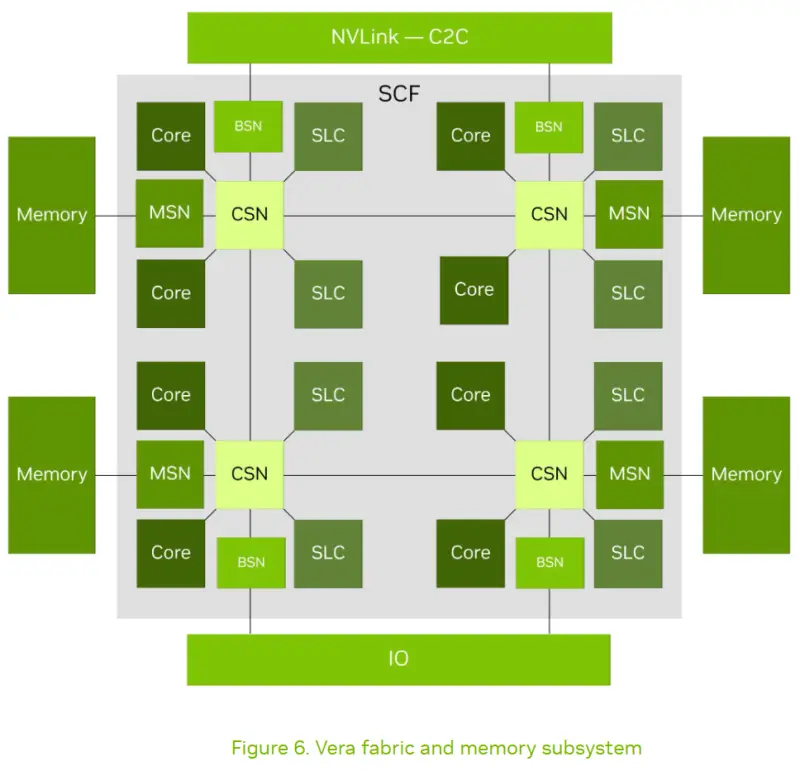
Feeding Vera’s Olympus cores is the second generation Scalable Coherency Fabric (SCF), a chip-wide network that connects cores, caches and I/O. Like the first generation used in Grace, Vera’s SCF is thought to use a mesh topology. Its Coherency Switch Nodes (CSNs) each host two cores and cache, reducing the number of network stops. Ampere’s Altra Max uses a similar pairing approach: each Arm CMN-600 request node hosts a DynamIQ Shared Unit with two Neoverse N1 cores.
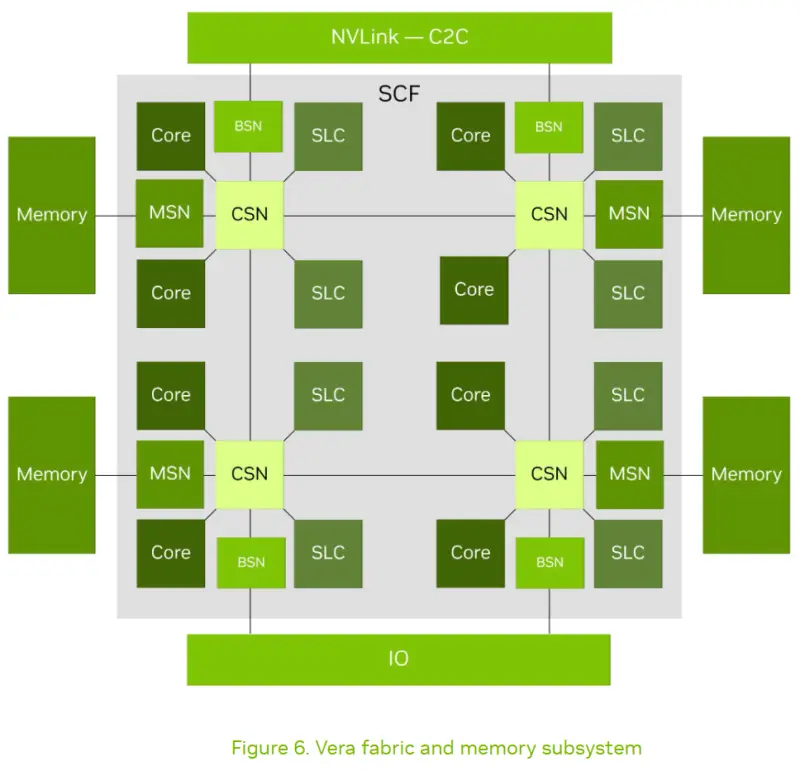
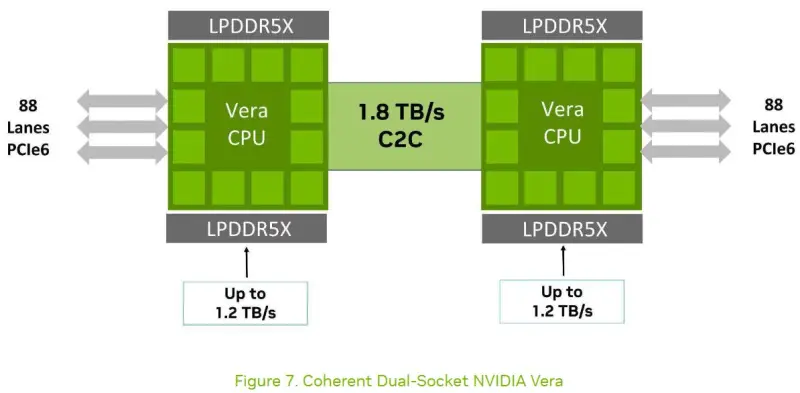
Memory Switch Nodes connect the fabric to Vera’s LPDDR5X memory controllers. The 1024-bit LPDDR5X-9600 interface offers up to 1.228 TB/s of bandwidth. Bridge Switch Nodes host PCIe controllers and the cross-socket connection. Vera has 88 PCIe lanes, with a combined 665.5 GB/s of bandwidth to peripherals, while NVLink C2C provides a theoretical 1.8 TB/s between sockets.
Memory bandwidth with controlled latency
The memory subsystem marks a major change from Grace. Grace’s LPDDR5X memory had latency above 200 ns and bandwidth that, while substantial, trailed contemporary DDR5 server chips. Vera’s much wider interface raises bandwidth above its peers, and its latency is reported to be comparable to DDR5-based systems. Vera also uses SOCAMM2 modules, making memory field serviceable and potentially upgradeable; Grace used soldered memory.

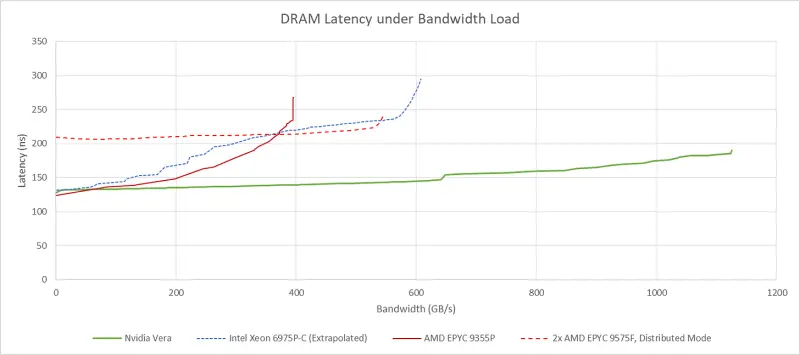
Vera’s latency behavior under load is notable. In pointer-chasing tests, latency stays below 200 ns even while other threads drive memory bandwidth toward its limit. Other server platforms can show a steep latency increase as demand nears the memory controllers’ capacity. Keeping latency steadier under contention should help limit interference between workloads sharing a system. It also gives Vera a path to outperform chips with more cores on DRAM-bound jobs.
A shared cache, with bandwidth trade-offs
Even 1.228 TB/s of memory bandwidth can’t serve every access directly, so Vera relies on a 164 MB L3 shared across all cores, alongside 2 MB private L2 caches. The L3 is non-inclusive of the L2s. If data isn’t duplicated across L2 caches, the combined L2 and L3 capacity can reach 340 MB. For data shared by several cores, the shared L3 can store one copy rather than repeating it across separate cache regions.
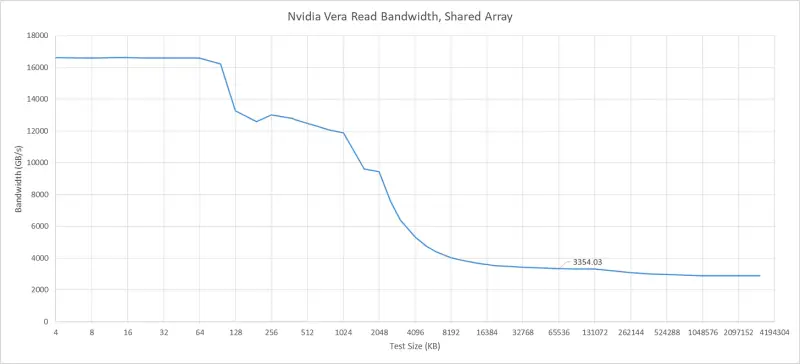
Measured L3 read bandwidth is about 3.35 TB/s, or 33.1 GB/s per core when divided across the chip. An uncontended core can reach 88.5 GB/s, so contention reduces the bandwidth available to each core. The 2 MB L2 caches should help by satisfying many accesses before they reach L3.
AMD’s Genoa-X takes a different approach. Its L3 is split into eight-core clusters, allowing each L3 instance to serve fewer cores at high bandwidth: a single core can reach 90 GB/s, falling to 85 GB/s when all cores on the die are active. Genoa-X also has 1248 MB of combined L2 and L3 capacity, which can suit workloads using mostly thread-private data or many separate jobs. Shared data may be duplicated across L3 instances, though, and a single thread can use only its 96 MB L3 instance. Vera’s shared L3 is smaller in total, but one thread can theoretically draw on the full 164 MB.
NVLink C2C: high throughput, costly remote access
NVLink C2C connects two Vera sockets in a dual-socket system. Each socket forms a NUMA node with its own directly attached memory, so accessing the other node adds a substantial latency penalty. Cross-node load-to-use latency measures 309.27 ns, 177.41 ns above local memory. That result requires traffic of a few dozen GB/s on the link; an isolated pointer-chasing test exceeds 370 ns. This suggests the link reaches a higher performance state when bandwidth demand builds and requests queue.
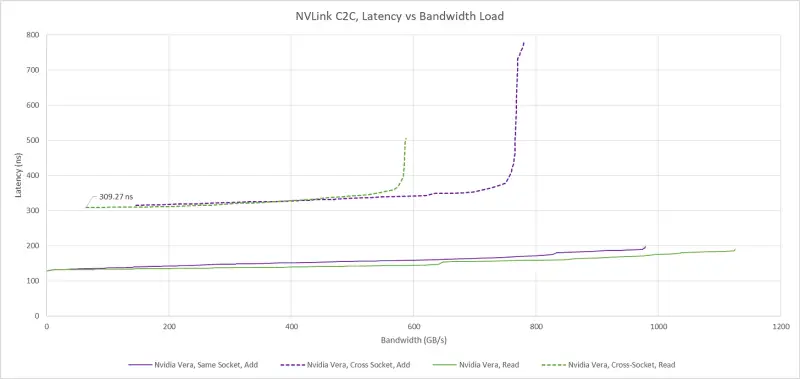
The link’s throughput is striking: reads exceed 587 GB/s, and a read-modify-write pattern moving data in both directions reaches 780 GB/s. But that pattern also pushes latency to 780 ns. Vera therefore pairs very high cross-socket bandwidth with latency that can rise sharply under load. For comparison, AMD Genoa-X measures 222.7 ns for cross-socket memory access.
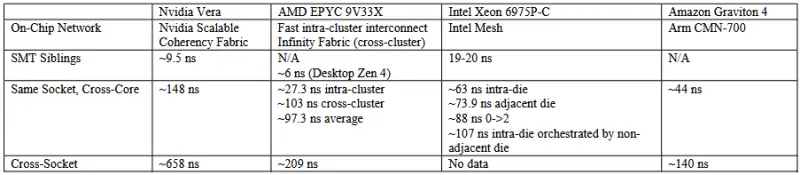
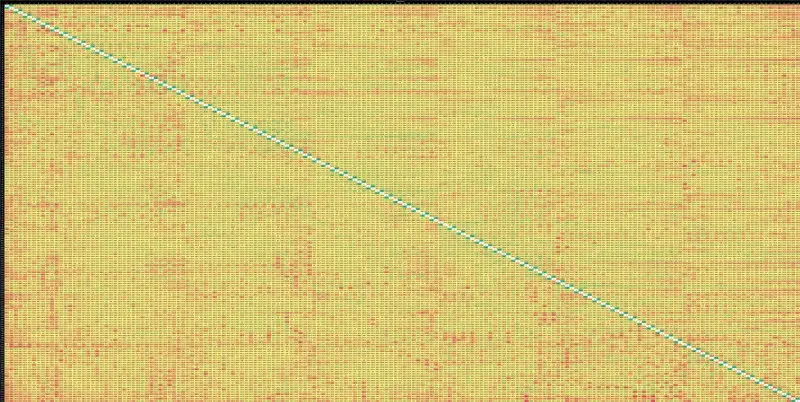
Core-to-core tests show a related divide. Within one socket, bouncing an atomic value between threads averages 148.5 ns, with results from 87.5 to 199.3 ns depending on the core pair and cache-line ownership. SMT siblings are below 10 ns, since coherence between those threads doesn’t need the slower cross-core path. Across sockets, core-to-core latency is about 660 ns. That’s well above Genoa-X’s roughly 209 ns and Amazon Graviton 4’s results, which are closer to older, lower-core-count designs. Vera’s intra-socket latency is consistent, but it is higher than Grace’s and the compared Genoa-X and Graviton 4 results.

Where the core count matters
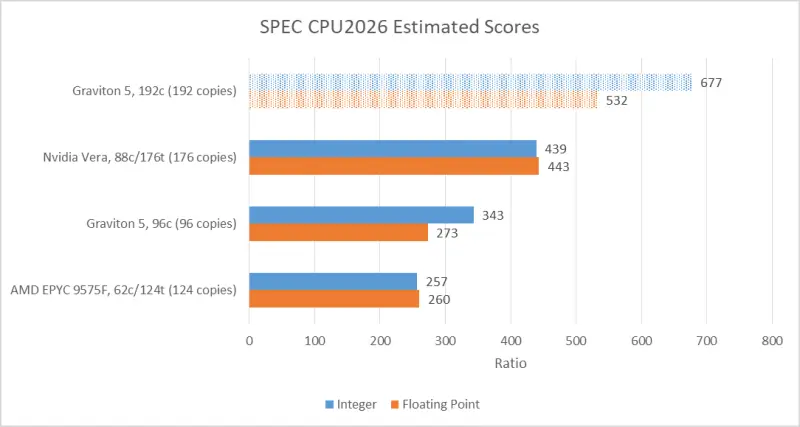
SPEC CPU2026 rate results illustrate Vera’s balance between per-core performance and total core count. With one benchmark copy per hardware thread, Vera beats Graviton 5 node for node, as well as a lower-core-count Zen 5 system configured with one NUMA node across both sockets. At the socket level, however, Vera falls behind Graviton 5. The comparison has a configuration caveat: Graviton 5 can’t expose its full socket as one NUMA node. Even so, the result captures a basic trade-off. A design with more, less powerful cores can deliver greater throughput when parallel work is plentiful. SMT narrows Vera’s gap, but it’s difficult to match a design with more than twice as many cores.
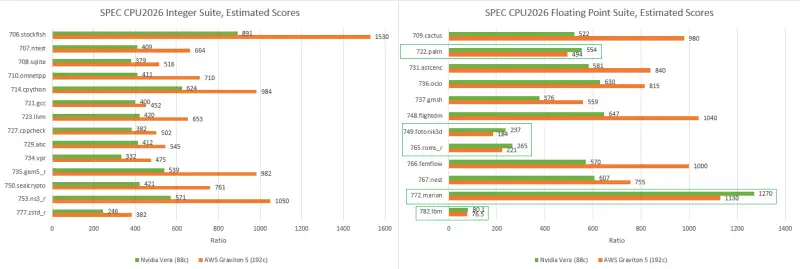
Bandwidth-heavy tests shift the comparison. In 749.fotonik3d, Vera leads Graviton 5 by nearly 20% in a socket-to-socket comparison despite having far fewer cores. The test places heavy demands on DRAM bandwidth, even with a single copy on a Ryzen 7 9800X3D. Several other SPEC CPU2026 floating-point tests also favor Vera. Graviton 5, by contrast, has a large advantage in workloads that fit its caches well.
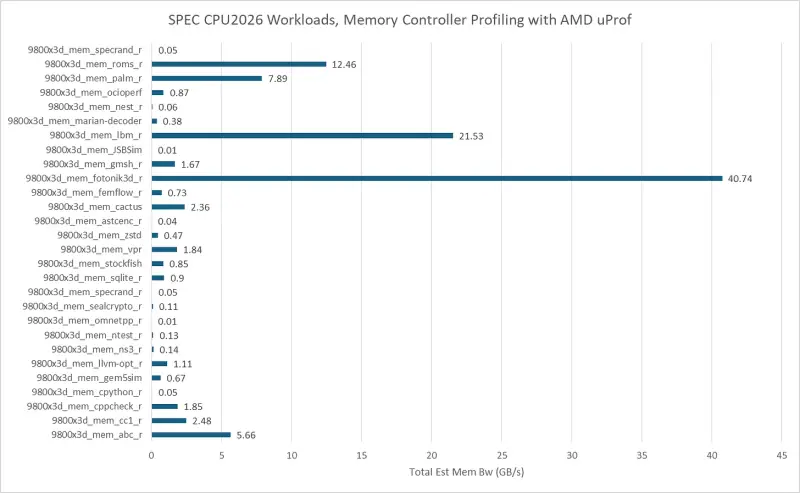
Vera looks best suited to work that rewards strong individual cores, high memory bandwidth or fast completion of tasks that don’t fill every core. Its shared cache and memory system give it room to serve bandwidth-sensitive workloads, while cross-socket latency and lower core count matter more when threads communicate frequently or parallel throughput is the priority. The practical choice will depend on whether a workload spends more time waiting on DRAM, sharing data between threads, or scaling across many cores.
 Choosing Single, Double, Welded Flap and Repair Keder for Fabrication
 Houston Engineering Team Builds a Welcoming Golf Tournament at East River 9
 MIG Transfer Modes: Choosing Between Short Circuit, Spray and Pulse