AMD Zen 6 and Zen 6c: Core Changes, Cache Trade-offs and SPEC CPU 2026 Results
Zen 6 boosts branch handling, instruction throughput and vector loads; Zen 6c trades clock speed for larger out-of-order structures and L3 cache.
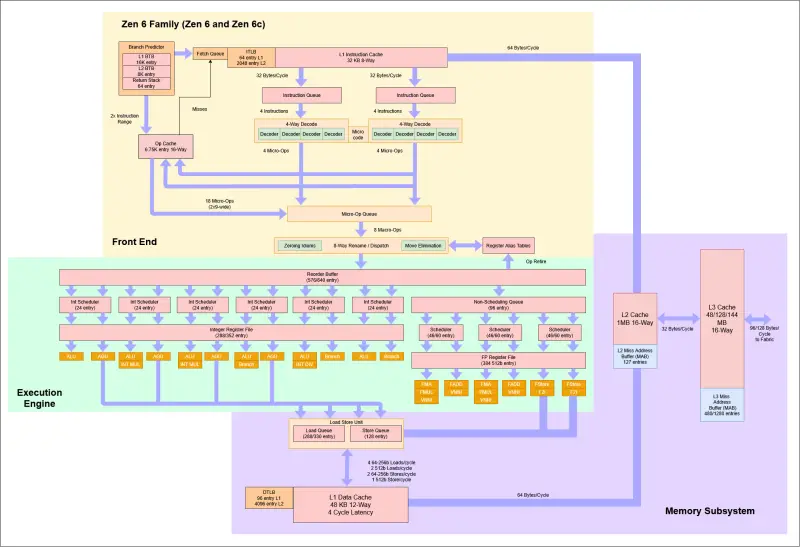
AMD’s Zen 6 family changes more than the performance of its core pipeline: it creates a clearer split between the high-clock Zen 6 and the denser, latency-tolerant Zen 6c. Both designs share substantial front-end and execution hardware, but their out-of-order capacities and cache configurations point to different workload strengths.
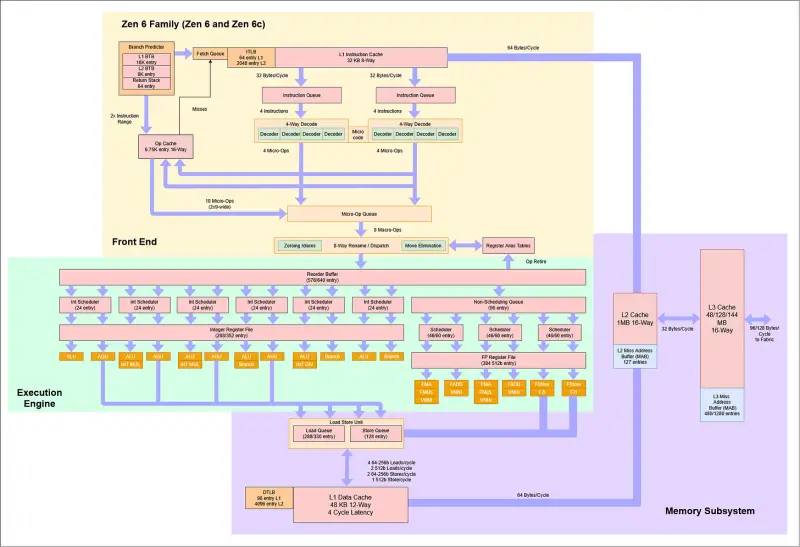
Measurements of the EPYC 9686F and EPYC 9996 suggest that this split matters in practice. The 9686F leads in estimated single-threaded SPEC CPU 2026 results, while the 9996’s larger shared L3 cache helps it hold up in memory-sensitive tests despite running at lower clocks. The architectural changes explain why neither core is simply a faster version of the other.
Branch handling and instruction fetch
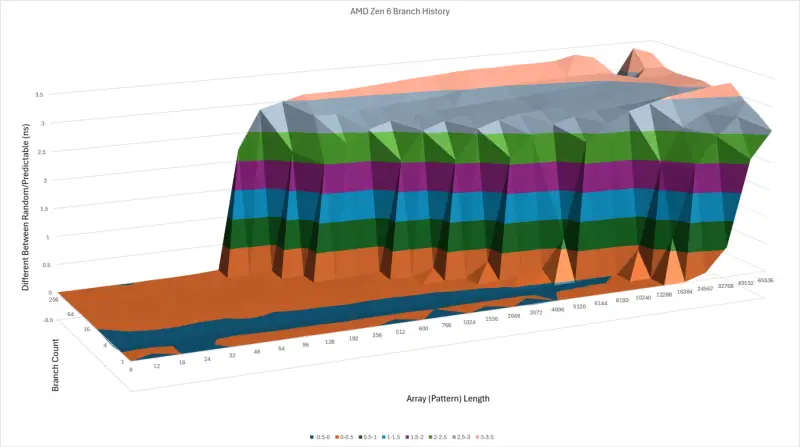
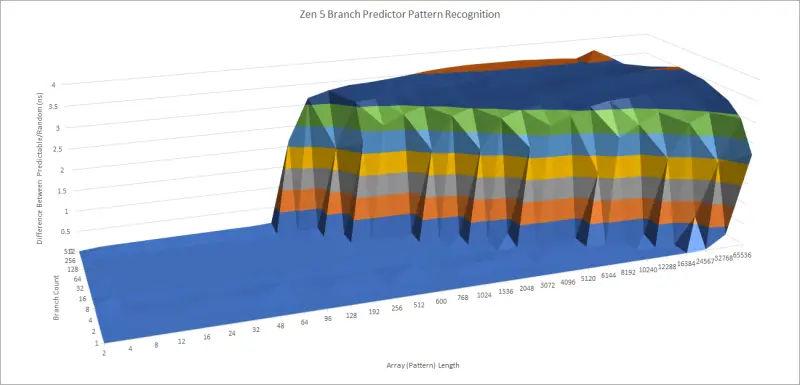
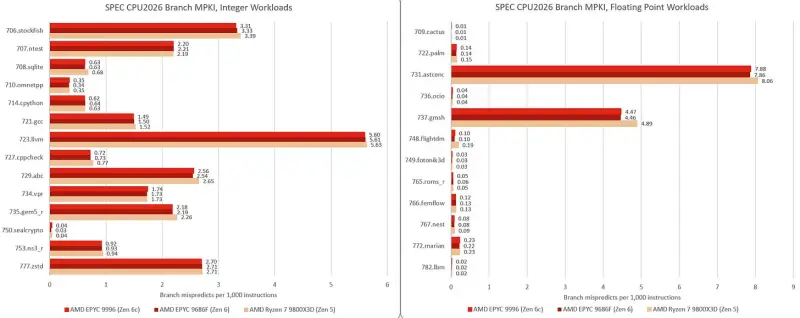
Zen 6 builds on the strong direction predictor measured in Zen 5. Its accuracy appears similar, but branch recovery is faster: once tests exceed the predictor’s capacity and mispredictions become effectively random, the added time per branch falls from roughly 3.5–4 ns on Zen 5 to about 3–3.5 ns on Zen 6. That points to a shorter misprediction penalty.
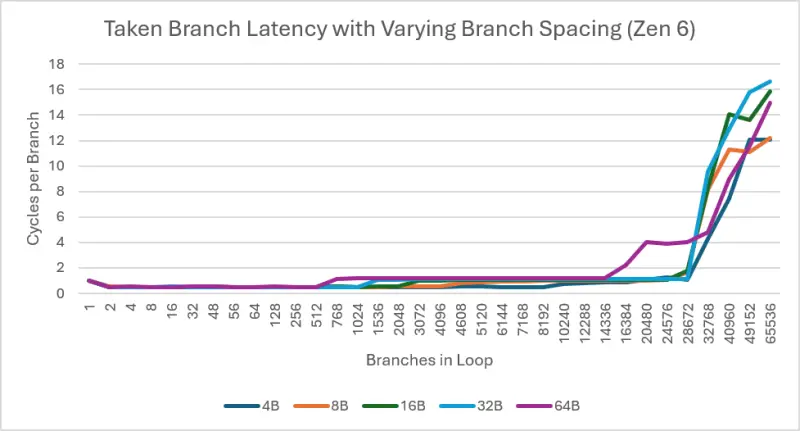
The branch target buffer (BTB) also changes its throughput behavior. Zen 6 can process two branches per cycle while the working set fits in the L1 instruction cache. Beyond L1, throughput falls to one branch per cycle across most of the BTB levels; the 64-byte test reaches four cycles per branch in the L2 BTB. Compared with Zen 5, the apparent emphasis is on BTB speed rather than greater capacity.
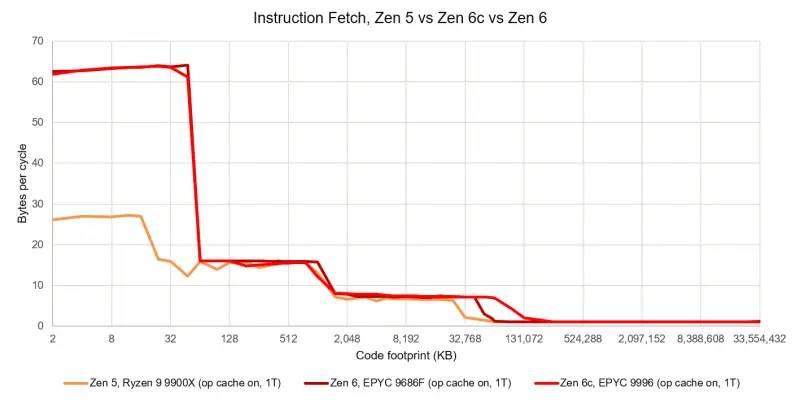
Zen 6 retains the dual decode cluster design introduced with Zen 5, but lets a single thread use both clusters. Zen 5 effectively limited one thread to one cluster. Outside the L1 instruction cache, instruction-side behavior looks much like Zen 5, so the main fetch change is making more decode capacity available to a single thread when it can use it.
Execution: more integer throughput, fewer multipliers
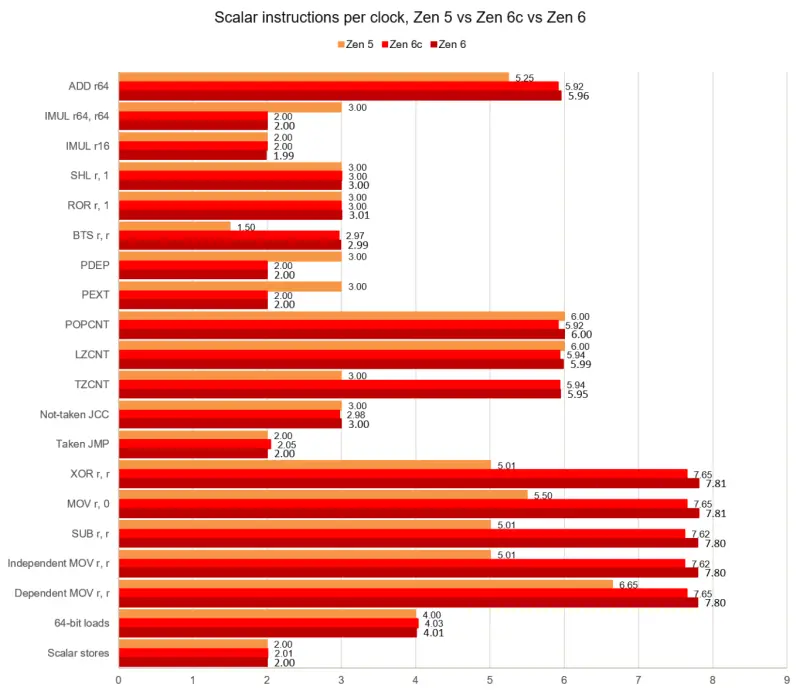
The integer engine combines a throughput gain with a deliberate reduction in hardware. Zen 6 restores Zen 4’s NOP pairing behavior, allowing it to retire up to 16 NOPs per cycle. With the same six ALUs as Zen 5, it sustains 5.96 64-bit adds per cycle in the measured test, up from 5.25. That brings simple integer performance closer to the core’s theoretical limit.
AMD has cut the number of integer multiply units from three to two. Throughput for PDEP and PEXT falls with it, from three instructions per cycle to two. AMD’s stated rationale is that Zen 5’s third multiplier did not earn its area cost. That is a clear trade: less silicon devoted to these operations in exchange for capacity elsewhere.
The floating-point units remain unchanged, handling two 512-bit FADDs, FMULs or FMAs per cycle. VNNI gets a substantial increase, with four units instead of two. In a 512-bit VNNI test, throughput rises from 1.99 to 3.88 instructions per cycle; Zen 6c matches Zen 6. VNNI can accelerate the inner loops used in quantized inference and video filters.
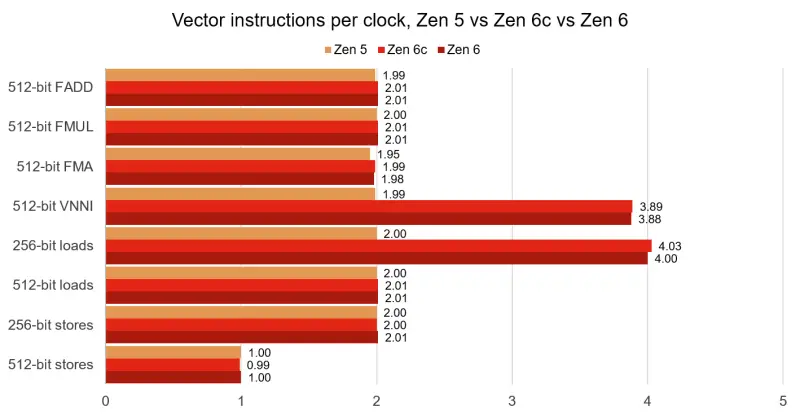
Vector load throughput also improves for 256-bit operations. Zen 5 could perform four vector loads per cycle overall, but only two could be vector loads, whether 256 or 512 bits wide. Zen 6 raises the 256-bit rate to four per cycle on both core types, while 512-bit loads remain at two. Both widths can therefore reach 128 bytes per cycle, a useful change for code targeting AVX1 or AVX2.

Zen 6c expands the out-of-order engine
The biggest architectural separation between Zen 6 and Zen 6c sits after micro-op dispatch and extends through the load queue. Earlier classic and dense core designs were described as functionally alike, with differences mainly in core count and L3 allocation. Zen 6 gives the two designs different capacities in several out-of-order structures.
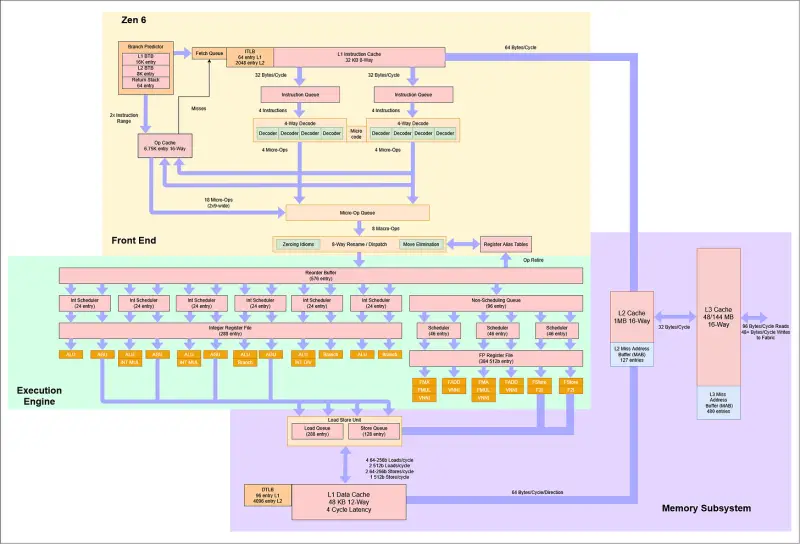
Zen 6c has a 640-entry reorder buffer compared with 576 entries on Zen 6. Its integer register file holds 352 entries versus 288, its vector scheduler has 180 entries versus 138, and its load queue reaches 330 entries versus 280. Larger structures can keep more independent work in flight, helping a core cover latency while waiting on data. The measurements suggest Zen 6 is oriented toward higher frequency, while Zen 6c has more room to absorb memory delays.
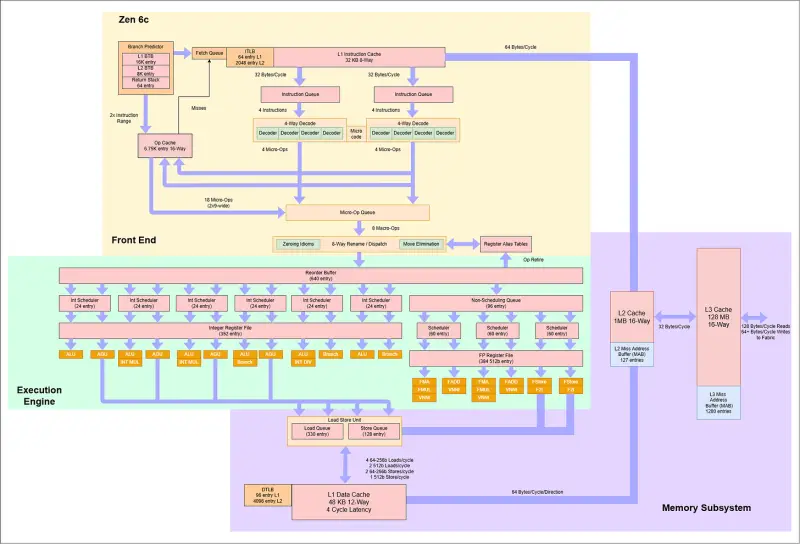
The CCD configurations reinforce that distinction. Zen 6 uses 12-core CCDs and Zen 6c uses 32-core CCDs; both provide 4 MB of L3 cache per core. That works out to 48 MB on a Zen 6 CCD and 128 MB on a Zen 6c CCD.
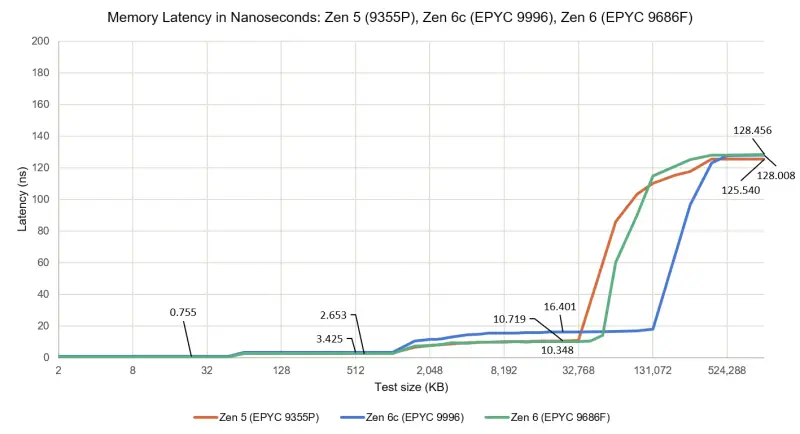
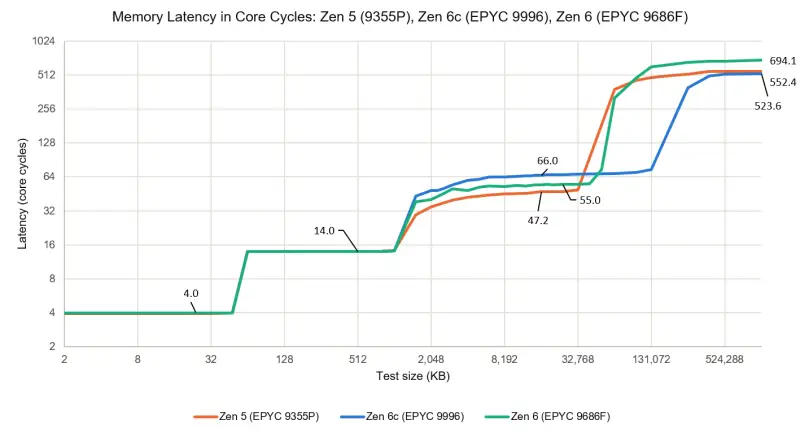
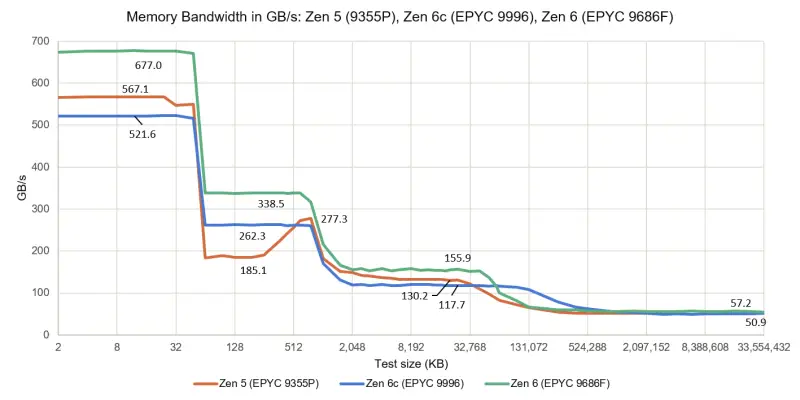
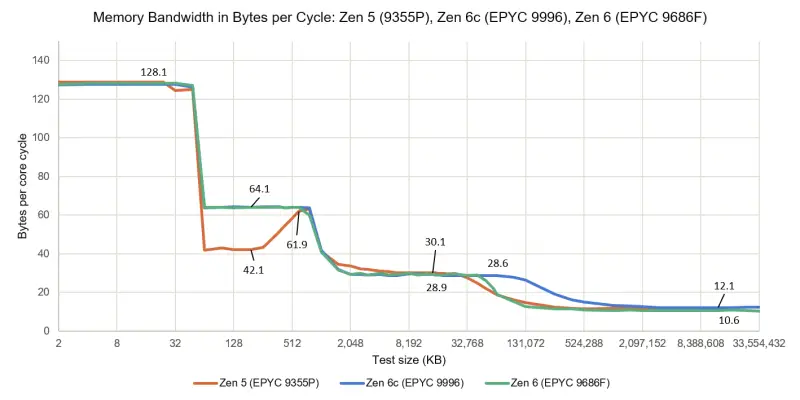
L3 latency rises from about 47 cycles on Zen 5 to 55 cycles on Zen 6 and 66 cycles on Zen 6c. Larger caches and more mesh stops are cited as likely contributors. Clock speed changes the comparison in time: Zen 6 measures 10.7 ns, close to the 10.3 ns of the Zen 5-based EPYC 9355P, while Zen 6c measures 16.4 ns. L2 read bandwidth also improves: Zen 5 delivered about 42 bytes per cycle across much of the cache, while Zen 6 provides a steadier 64 bytes per cycle. Bandwidth per cycle elsewhere in the cache hierarchy is largely unchanged.
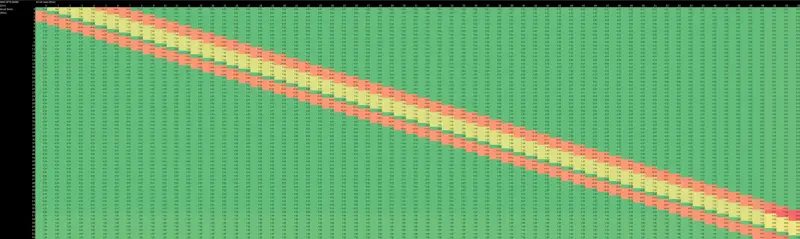
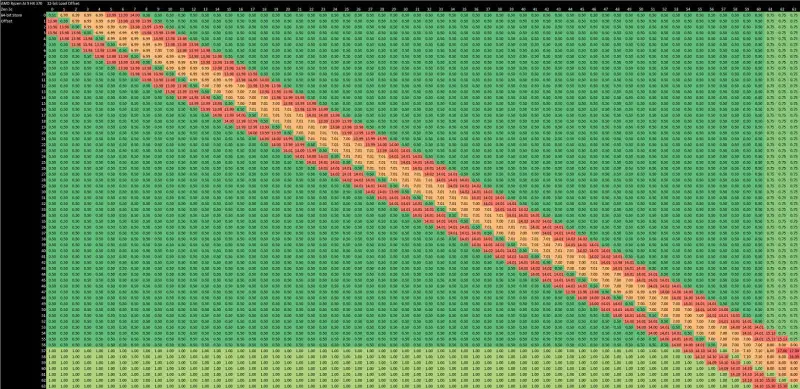
Load-to-store forwarding appears consistent across the two Zen 6 designs and similar to Zen 5. A 32-bit load from the same address as a 64-bit store completes with effectively zero latency, enabling two dependent store-load pairs per cycle. Loads fully covered by a store take 7 cycles regardless of alignment; partial overlaps take 14 cycles.
SPEC CPU 2026: clock speed and cache capacity pull apart
Estimated single-threaded SPEC CPU 2026 results put the EPYC 9686F near the top of the tested set. It roughly matches the previous-generation Ryzen 9 9950X3D2 in integer rate and exceeds it in floating point. At a matched 4.1 GHz, the 9686F leads by about 4% in integer and 11% in floating point, despite the X3D processor’s much larger L3 cache.
The EPYC 9996 roughly matches the previous-generation EPYC 9575F in single-threaded performance while running about 900 MHz slower and carrying four times as many cores. It also edges NVIDIA’s Vera in integer performance and leads by about 20% in floating point.
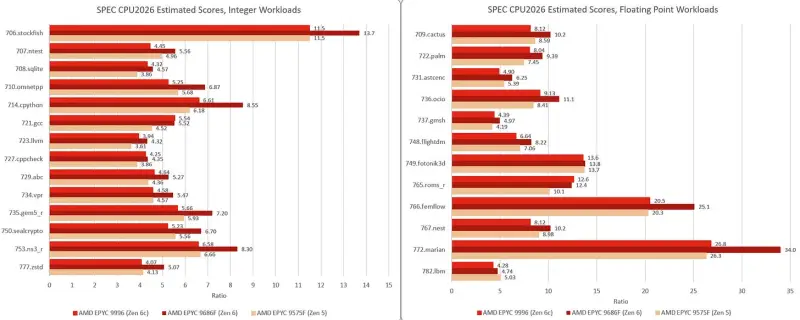
Across the reported suites, the 9686F finishes about 18% ahead of the 9996, scoring 6.20 versus 5.25 in integer and 10.6 versus 8.99 in floating point. Its strongest leads include 714.cpython, 766.femflow and 772.marian. Against the EPYC 9575F, the 9996 scores 5.25 versus 5.13 in integer and 8.99 versus 9.01 in floating point. It also beats the 9686F in 721.gcc and 765.roms, where the higher clock of the 9686F doesn’t translate into a lead.
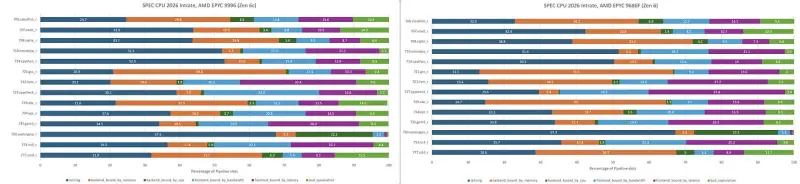
Pipeline slot breakdowns show that core-bound integer tests look much alike on the two Zen 6 chips. In 750.sealcrypto, 710.omnetpp, 735.gem5 and 753.ns3, their retiring-slot shares differ by less than one percentage point. Memory-heavy tests separate them more clearly: backend memory stalls rise from 37.9% on the 9996 to 50.0% on the 9686F in 729.abc, from 19.0% to 34.1% in 723.llvm, and from 24.8% to 33.2% in 708.sqlite.
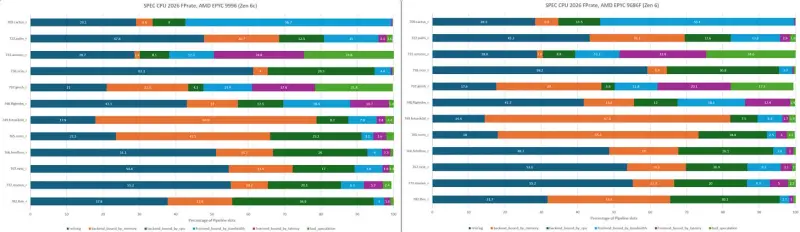
The floating-point results show the same pattern. In 765.roms, memory stalls account for 42.5% of slots on the 9996 and 55.3% on the 9686F; in 749.fotonik3d, the figures are 60.9% and 67.6%; in 782.lbm, they are 17.8% and 33.8%. These are workloads where the 9686F’s higher clock helps least: it trails the 9996 in 765.roms, roughly ties in 749.fotonik3d and leads by about 11% in 782.lbm, despite clocking up to roughly 29% higher.
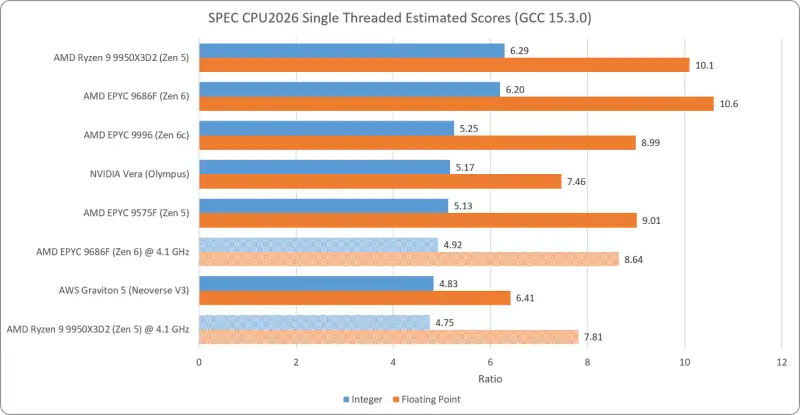
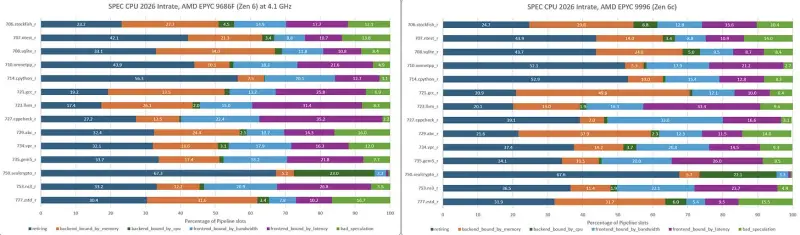
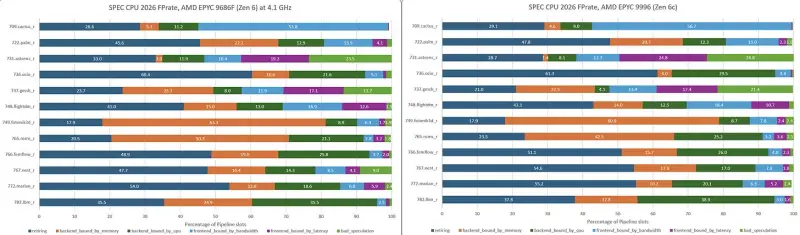
Matching the 9686F to the 9996 at 4.1 GHz changes the aggregate comparison. The 9686F scores 4.92 in integer and 8.64 in floating point at that clock, putting Zen 6c about 6.7% ahead per clock in integer and 4% in floating point. In core-bound integer tests, the chips are nearly identical: 750.sealcrypto has retiring-slot shares of 67.3% on the 9686F and 67.6% on the 9996.
At matched clocks, Zen 6c still shows an advantage in memory-sensitive work. The 9686F records higher memory-stall shares in 765.roms, 782.lbm and 749.fotonik3d. The 9996’s 128 MB L3, compared with 48 MB on the 9686F, likely serves more requests before they reach main memory. Large codebases also bring more front-end latency stalls on the 9686F: 35.2% versus 16.6% in 727.cppcheck and 25.8% versus 10.0% in 721.gcc. With clock speed matched and the front ends shared, the cache and memory hierarchy is the likely source of much of that difference.
A family split shaped around workload behavior
Zen 6 brings a faster branch recovery path, lets one thread use both decode clusters and improves integer, VNNI and 256-bit load throughput. Zen 6c shares much of that foundation, but its larger out-of-order structures and bigger per-CCD L3 change how it handles latency. The SPEC results reflect that design choice: Zen 6’s higher clocks help it lead in many single-threaded tests, while Zen 6c’s cache and capacity can pay off in workloads that wait on memory.
For engineers comparing the two, clock rate alone won’t describe the trade-off. Code footprint, cache locality and memory stalls help determine whether Zen 6’s frequency or Zen 6c’s greater capacity has the advantage.
 Choosing Single, Double, Welded Flap and Repair Keder for Fabrication
 Houston Engineering Team Builds a Welcoming Golf Tournament at East River 9
 MIG Transfer Modes: Choosing Between Short Circuit, Spray and Pulse