AMD Zen 6 Reworks Core Scheduling, Cache Traffic and Branch Recovery
Mike Clark explains how Zen 6 and Zen 6c balance frequency, core density, vector throughput and cache bandwidth across AMD’s next-generation CPU designs.
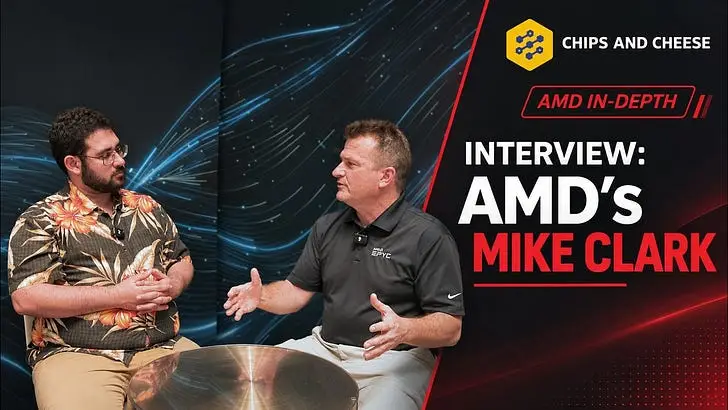
AMD’s Zen 6 design changes more than the balance between core density and clock speed. Mike Clark, the original Zen architect, describes a broader redesign: Zen 6c gains roomier queues and a larger floating-point scheduler, while the core family also revisits integer scheduling, vector execution, cache traffic and branch recovery. The aim is to raise performance without making software treat the two core types as different architectures.
Clark discussed the designs with George Cozma at AMD In-Depth, in a conversation about the Venice processor generation. He said AMD has been developing two core families since Zen 4. Earlier dense cores mainly used denser manufacturing technology to fit more cores into an area. For Zen 6, AMD has also used that design approach to improve the dense core’s performance.
Two core designs, one software target
AMD now describes the traditional core design as its high-frequency core. Zen 6c, by contrast, is intended to be a high-performance core in its own right, rather than simply a smaller version for packing into a processor. Clark said AMD enabled the full L3 cache in this implementation, with 4MB per core. A configuration with 32 such cores provides 128MB of L3.
That distinction comes with different frequency targets. Zen 6c doesn’t need to reach the maximum frequency expected of the high-frequency core, which gives its designers more room to increase capacity in queues throughout the core. Clark pointed to the floating-point scheduler as one example. Those larger structures can help recover instruction throughput, or IPC, and make better use of simultaneous multithreading (SMT).
The design constraint, Clark said, is to preserve the same “fit and feel” across both core types. If the cores behave similarly enough, software optimizations can apply to both instead of requiring separate tuning for each architecture. The internal structures can differ while the programming model remains consistent.
Front end: making dual decode work efficiently
Zen 5 established a new front-end design that can fetch two basic blocks and send them down the pipeline. Clark said Zen 6 builds on that foundation by improving how the front end handles instruction delivery and power use. The challenge is coordination: a workload may draw instructions partly from the instruction cache and partly from the operation cache, and the core must keep those paths synchronized.
AMD spent time improving that coordination, Clark said, to reduce wasted power and deliver instructions more efficiently. The work is less about adding a new headline feature than getting more from the dual-decode arrangement already introduced in Zen 5. That matters especially when a single thread runs a workload with a large instruction footprint.
Execution resources and vector work
One visible change in the integer execution engine is a reduction from three integer multiply units to two. Clark traced the decision to a change in scheduler organization. Zen 5 used a more unified scheduler, where adding a third multiplier was straightforward because the scheduled units were arranged to be uniform. Zen 6 moves back toward distributed schedulers that issue work to the arithmetic logic units.
In that arrangement, AMD saw little performance gain from keeping the third multiplier. Removing it helped manage area and scheduler complexity as the architecture scales. Clark’s explanation points to a recurring design trade-off: execution capacity has to earn the space and control logic it consumes.
On the vector side, Zen 6 adds two VNNI units. Clark said the long development cycle began before “agentic” computing had become a common term, but AMD had already been treating CPU cores as useful for parts of AI workloads, including orchestration, data type manipulation and smaller models. He stressed that the CPU core isn’t intended to outperform a GPU at its main role. The case for additional VNNI capacity came from the direction of inference workloads.
The change came relatively late, after the floor plan had been set. Clark said the team managed to fit two more VNNI pipes into the design. That account shows how a long-lead processor project can still accommodate a targeted change when the expected workload mix shifts, though it also underscores the physical constraints involved.
Zen 6 also expands vector load capability. Clark confirmed that the core can perform four vector loads when they are 128 or 256 bits wide, and said it can handle 256-bit loads. Zen 5 already had 1,024 wires available because it supported two 512-bit loads, but using those paths as separate smaller transfers adds design complexity. AMD had wanted to make that use of the wiring in Zen 5, Clark said, but left it for the next core generation while the earlier design was being brought together.
Cache bandwidth and branch recovery
Zen 6 addresses a measured limitation in Zen 5’s L2 read bandwidth. Cozma said Zen 5 couldn’t always reach 64 bytes per cycle for reads, while his measurements of Zen 6 showed it could. Clark attributed the earlier shortfall in part to prefetches that hit in L2 taking bandwidth away from demand requests. Zen 6 was designed to sustain prefetch traffic alongside those requests, reducing conflicts and allowing the cache to deliver the intended 64 bytes per cycle.
Branch handling is another area where the stated goal is efficiency. Cozma observed that Zen 6 reduces the latency to recover from a branch misprediction without reducing prediction accuracy; he also described accuracy as slightly better than Zen 5’s. Clark credited the branch prediction team’s work exploring table arrangements and prediction algorithms. He said AI has also been used to help explore optimization choices.
Even a highly accurate predictor will miss some branches, Clark said, so AMD also focuses on shortening the path back to useful execution. That means getting the redirect into the front end quickly and restarting instruction flow. The design work combines prediction accuracy with pipeline recovery time, since both affect the cost of a misprediction.
Scaling the cache and memory interface
AMD’s 12-core and 32-core chiplet designs have different L3 topologies, and larger structures can increase the physical distance that data travels. Clark said denser technology can limit how quickly that distance grows as capacity increases, but it doesn’t eliminate the added distance. He declined to describe the internal techniques used to preserve bandwidth across the L3 mesh. Within the cores, AMD also increases queue capacity to tolerate higher latency.
The discussion also touched on Verano’s support for LPDDR5X in the EPYC product family. Clark said the core team focuses on bandwidth per core and on providing enough bandwidth between the core complex die (CCD) and the I/O die (IOD). He cited 32-byte reads per port on the SDP ports, as discussed by Mahesh. Since the existing design was already provisioned for bandwidth with MRDIMMs, Clark said the memory technology choice and related construction didn’t require a major change to the core.
For engineers comparing the Zen 6 family with Zen 5, Clark’s account sketches a generation built around selective changes: more queue capacity where latency and frequency targets allow it, a simpler integer multiply arrangement, more VNNI throughput, wider use of existing vector wiring, and fewer conflicts between prefetch and demand traffic. Cozma also reported that Zen 6c matched AMD’s fastest Zen 5 server CPU in SPECint 2026 despite a clock deficit, based on his hands-on testing. Further performance comparisons will show how those core-level changes combine with differences in cache topology and operating frequency.
 Choosing Single, Double, Welded Flap and Repair Keder for Fabrication
 Houston Engineering Team Builds a Welcoming Golf Tournament at East River 9
 MIG Transfer Modes: Choosing Between Short Circuit, Spray and Pulse