TITAN’s VH Module Combines Wideband Haptics with Universal Haptics Protocol
TITAN’s compact VH Module supports two actuator channels, audio-to-haptics and UHP 1.0, giving developers more ways to create tactile feedback.
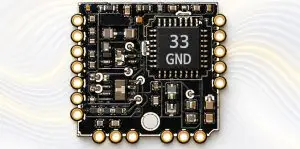
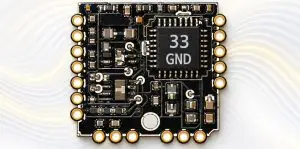
More convincing touch feedback depends on two things: actuators that can produce a range of sensations, and a practical way for software to describe those sensations across products. TITAN Haptics’ VH Module brings both concerns into focus. The 10.8 × 10.8 mm subsystem combines embedded signal processing and drive electronics with support for the Universal Haptics Protocol (UHP) 1.0, a shared specification for describing and controlling haptic effects.
The module’s significance is easier to see against the limits of older vibration hardware. An eccentric rotating mass (ERM) motor spins an off-center weight to shake the device around it. That mechanism works for a pager buzz or a game controller rumble, but the motor needs time to accelerate and slow down. The delay makes brief, sharply timed sensations difficult, and a simple buzz conveys only so much detail.
From vibration motors to force feedback
Haptics covers technologies that communicate through touch. A useful distinction is between tactile interfaces, which rely on physical features that can be felt, and active haptic systems, which deliberately generate forces or vibrations. Louis Braille’s raised-dot writing system, developed around 1824, is a tactile interface: it communicates information through touch without producing active force feedback.
Remote manipulators developed at Argonne National Laboratory in the 1940s offered an early example of force feedback. Mechanical linkages carried forces from the remote gripper back to its operator, allowing the person to feel resistance when the gripper met an object.
Aviation produced another early application. Pilots in smaller aircraft could feel aerodynamic buffeting through mechanically linked flight controls as the aircraft approached a stall. That natural warning could be unreliable, and powered controls in larger aircraft further separated pilots from forces acting on control surfaces. Designers responded with “stick shakers”: devices that monitored flight conditions, including angle of attack, and vibrated the control column when a stall was imminent.
For decades, these systems remained specialized. Computers, games, virtual reality and mobile devices brought haptics into everyday products, though early consumer hardware also showed how much software support matters. The Logitech iFeel MouseMan, which appeared around 2000 and used technology from Immersion Corporation, could vibrate as a cursor passed over a link or button, or reached a window edge. The effect offered a way to feel parts of a graphical interface, but the mouse relied on specialized software and lacked broad support across applications. Its capabilities were therefore hard to use consistently.
That history points to a persistent engineering problem: a capable actuator is only useful when software can address it reliably. Apple’s Taptic Engine showed how a controlled vibration can simulate a physical click. In an iPhone Home button, the apparent movement came from a vibration rather than a conventional mechanical switch. Smartphones and game controllers now use touch feedback routinely, but richer effects require tighter control over the actuator’s output.
Wider response from magnetic suspension
Linear resonant actuators (LRAs) improve on ERM motors by using electromagnetic forces to move a mass back and forth. They can create more controlled sensations; Apple’s Taptic Engine is one familiar example. Conventional LRAs still work most effectively over a limited frequency range, however.
TITAN Haptics, based in Toronto, was incorporated in 2021, while its underlying technology originated several years earlier in a Silicon Valley research laboratory. Its Linear Magnetic Ram (LMR) actuators use magnetic suspension instead of the mechanical springs found in traditional resonant actuators. TITAN says this arrangement allows the actuators to respond across a wider frequency range, supporting a broader set of tactile effects.
The operating idea resembles a loudspeaker. A speaker moves air to create sound; a haptic actuator couples mechanical motion into a device so a user can feel it. That could let a controller produce distinct sensations for something like raindrops, an engine rumble or an impact, or let a touchscreen provide a simulated click without a moving switch underneath.
A shared language for haptic effects
More capable hardware creates a control challenge. Manufacturers have historically used different methods to describe, generate and play back haptic effects. That variation complicates development when designers want a consistent experience across devices and platforms.
The Haptics Industry Forum (HIF) developed the Universal Haptics Protocol 1.0 to address that gap. Announced in September 2026, UHP provides a common way to describe effects, identify device capabilities, route effects to actuators and control playback. HIF members include Logitech and iRacing. TITAN is also a member, and its founder and CEO, Tim Szeto, chairs the working group responsible for developing the protocol.
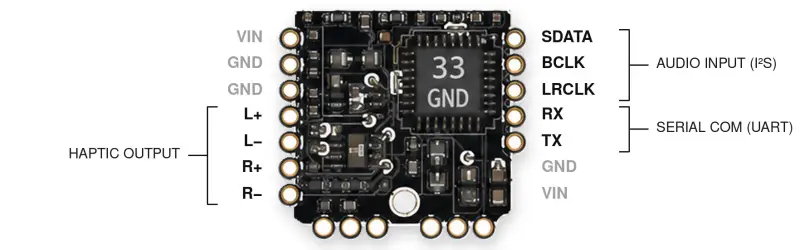
The VH Module is the first product on the market to implement UHP 1.0. It measures 10.8 × 10.8 mm and contains a haptic processing and drive subsystem. The module itself does not vibrate: it generates and amplifies electrical signals for external actuators, including TITAN’s LMR devices.
Onboard digital signal processing (DSP) supports two independently controlled actuator channels, with up to 3W per channel under specified operating conditions. A host microcontroller communicates with the module through a serial UART interface, while an I²S input accepts digital audio.
Audio input and programmable effects
The I²S connection enables audio-to-haptics. A game controller, for example, can receive the digital audio stream already produced by a game and process it in real time to generate corresponding tactile sensations. The module’s DSP can filter and equalize that input, giving developers control over which sounds produce vibration and how the result feels. That filtering matters when audio includes speech or other content that shouldn’t make a controller respond.
For effects that need more deliberate timing or shape, TITAN offers its Vector Haptics API. Developers build sensations from primitives such as pulses, ticks, vibrations, pauses and frequency sweeps. They can set parameters including duration, intensity, frequency and sharpness, combining the basic elements to define a particular effect.
Instead of storing a full sampled waveform, a host microcontroller can keep a compact description of an effect and send it to the module, which generates the waveform. Audio-derived sensations and API-defined effects can also run together. A controller might play a continuous low-frequency engine rumble from audio while adding a brief click for a control input and a stronger jolt for an impact. With two independently controlled channels, those sensations can be sent to separate actuators.
That combination of processing, amplification and control in one small module could reduce the number of separate components and custom interfaces a developer needs to assemble. It also puts greater emphasis on the design of the effects themselves. As Szeto described it, creating good haptics is an art: intensity alone doesn’t make feedback convincing. Timing, subtlety and contrast shape what a user perceives.
Potential uses extend beyond gaming to augmented- and virtual-reality headsets, automotive controls, wearables, medical equipment and computer mice. The practical test for UHP and modules such as TITAN’s will be whether developers can use them to deliver tactile cues consistently across products. The hardware can produce more varied sensations; shared control methods may help make those sensations useful in everyday interfaces.
 Choosing Single, Double, Welded Flap and Repair Keder for Fabrication
 Houston Engineering Team Builds a Welcoming Golf Tournament at East River 9
 MIG Transfer Modes: Choosing Between Short Circuit, Spray and Pulse