Analog Compute-in-Memory Brings Low-Power AI to Edge Devices
SST’s memBrain uses flash cells for parallel AI computation, while AnalogAI aims to add on-device adaptation within a one-watt power budget.


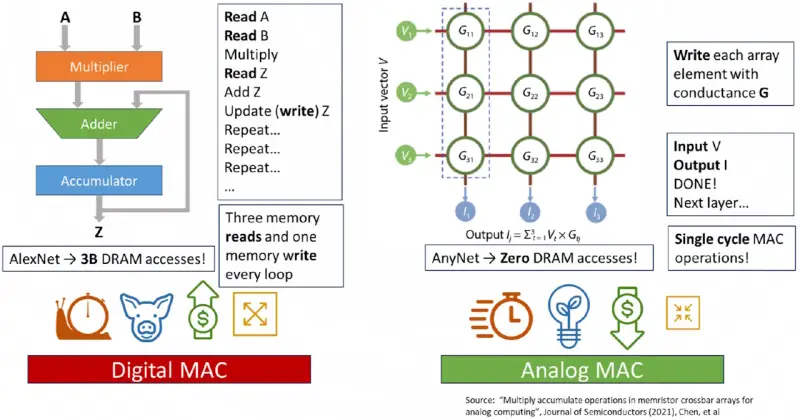
Running neural networks near a sensor or machine can save the delay and connectivity demands of sending data to a remote server. The trade-off is energy: conventional processors repeatedly move model weights between memory and arithmetic units. Silicon Storage Technology’s memBrain SAGE takes a different route, using flash memory cells to carry out multiply-accumulate operations where the model data is stored. AnalogAI has selected that intellectual property for edge processors intended to infer and adapt locally, with a target power consumption of one watt or less.
SST is a subsidiary of Microchip Technology and develops flash memory technology and related IP. Its memBrain SAGE name expands to Synaptic Analog Generative Engine. Semiconductor designers can incorporate the IP into application-specific integrated circuits (ASICs) and systems-on-chip (SoCs); it is an analog compute-in-memory (aCIM) architecture built around SST’s embedded SuperFlash.

The companies behind memBrain SAGE and its edge processor use. (Source: Microchip)
Using flash cells to perform MAC operations
Neural networks rely heavily on multiply-accumulate (MAC) operations: multiplying input values by model weights, then adding the products into a result. In a conventional digital system, arithmetic circuitry performs those steps after retrieving values from memory. GPUs can process many operations in parallel, but the repeated movement of data still costs time and energy.
memBrain encodes network weights as analog conductance levels in flash cells. Each cell can represent 32 distinct levels, equivalent to five bits. When a voltage is applied, the current through a cell reflects the product of that voltage and the cell’s conductance. The cell therefore contributes a multiplication through its electrical behavior.
The array handles the accumulation. Applying input voltages to multiple rows produces currents that add along the columns. That lets the array perform many MAC operations in parallel, without transferring every weight to a separate arithmetic unit. The potential benefit is especially relevant in edge devices, where power and heat budgets can limit how much computation a system can sustain.
The IP package includes more than memory arrays. It also provides analog control circuitry, digital-to-analog converters (DACs), analog-to-digital converters (ADCs), simulation models, test programs and software for preparing and loading neural-network models. Those supporting blocks matter because a usable compute-in-memory design must connect analog operations to digital inputs, outputs and development workflows.
SST developed memBrain for established foundry processes at 40nm and 28nm, rather than requiring a new manufacturing process. The cells operate at currents from 1 to 100 nanoamps, according to David Eggleston, Associate Director of Business Development at Microchip Licensing Division. A conventional flash cell might use a read current of 10 microamps or more. memBrain reaches its lower operating range by using transistors in the subthreshold region, a design approach that requires careful control.
Efficiency depends on the workload
Eggleston shared a comparison using a YOLOv5 neural network for video-based threat detection. In the figures he provided, a GPU system processes 200 frames per second at 60 watts. An aCIM implementation processes 150 frames per second at 3 watts. That works out to 50 frames per second per watt for aCIM and about 3.33 for the GPU, or roughly 15 times the energy efficiency in this particular comparison. SST’s figures also indicate a lower silicon die cost for the aCIM implementation.
Those results describe one workload and comparison; they don’t establish that analog compute-in-memory is a general replacement for GPUs. GPUs remain suited to large models, flexible workloads and high throughput. memBrain’s case is narrower: place neural-network computation close to the data, and reduce the energy spent moving weights around. For a battery-powered or thermally constrained system, a lower frame rate may be a worthwhile trade if it comes with a much smaller power requirement.
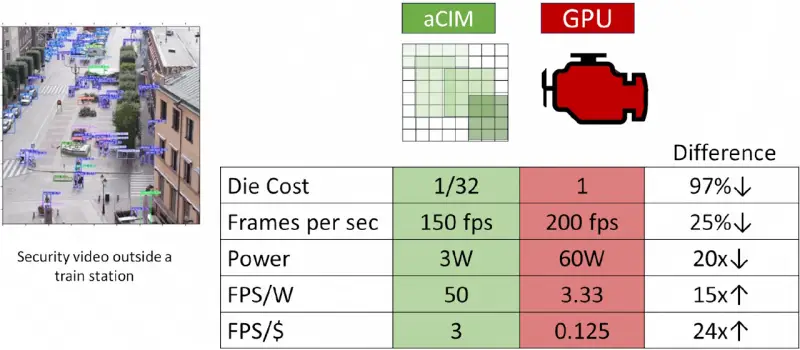
Performance and power figures for the GPU and aCIM comparison. (Source: Microchip)
AnalogAI’s aim: adaptation on the device
AnalogAI, a South Korean edge AI processor company, is pairing memBrain SAGE with its own hardware-aware algorithms. Its stated goal is to let devices continue to adapt to changing conditions after deployment, while performing inference locally. Conventional deployment often separates training, which runs on powerful computing systems, from inference, which runs on the finished device. AnalogAI is pursuing processors that can adjust their behavior in the field rather than depending solely on a fixed model or a remote server.
That capability could matter in settings where inputs change over time, such as a robot moving through unfamiliar surroundings or a drone facing different lighting and weather. The company is also targeting autonomous vehicles, industrial machines and other systems that may need local decisions when network access is limited. Its processor plans are still at an early stage, and the one-watt-or-less figure is a target, not a reported measurement of a shipping device.
Putting adaptation on a low-power processor creates a different engineering challenge from simply running inference. The hardware and algorithms need to fit within a small energy budget while responding to changes in the environment. memBrain supplies the in-memory computation; AnalogAI’s contribution is the processor design and algorithms intended to use that capability for ongoing adaptation.
A growing set of licensees and products
AnalogAI is the fourth publicly announced memBrain licensee, according to Eggleston. The sequence began with Witmem, which adopted the technology for low-power speech processing in February 2022. Intelligent Hardware Korea followed in September 2023 with plans for analog compute platforms focused particularly on edge computer vision.
In October 2024, GlobalFoundries, Witmem and Microchip announced sampling of Witmem’s WTM-8 video processor, specified to handle 8K video at 120 frames per second. In March 2026, Mythic announced it had selected memBrain for its next generation of ultra-low-power analog processing units. AnalogAI’s selection was announced in September 2026.
There is also a consumer product example. Anker’s Soundcore Liberty 5 Pro and Liberty 5 Pro Max wireless earbuds use the THUS AI audio chip, a co-developed processor that runs AI computations locally. Eggleston said Witmem supplies the underlying silicon incorporating SST’s memBrain technology. The earbuds illustrate how compute-in-memory can serve a small, battery-powered product, where running audio processing locally can avoid dependence on cloud connectivity.
Microchip and SST identify potential uses across smart speakers, security cameras, augmented-reality glasses, medical devices, drones and industrial robots. Those products have different accuracy, latency and energy requirements, so the value of aCIM will depend on the model and task being run. The engineering question to watch is whether licensees can turn the low-current array architecture into products that meet those application needs while preserving its power advantage.
 Choosing Single, Double, Welded Flap and Repair Keder for Fabrication
 Houston Engineering Team Builds a Welcoming Golf Tournament at East River 9
 MIG Transfer Modes: Choosing Between Short Circuit, Spray and Pulse