Circuit Mind Adds AI-Assisted Schematic Verification to Its Electronic Design Platform
Circuit Mind’s ACE, AVE and Elixir combine structured component data, algorithms and AI to support professional electronics design and review.

Finding a schematic error before it reaches a prototype can save weeks of redesign work. Circuit Mind is building a platform around that practical problem: ACE generates circuit designs, while its new AVE application checks schematics for issues that can escape a conventional review. The company says its tools are aimed at professional engineering teams, where designs must fit established workflows and component rules as well as meet their electrical requirements.

The change reflects a broader shift in Circuit Mind’s offering. Its flagship product, ACE (Assistant to Circuit Engineers), began as a tool that takes high-level requirements expressed as a block diagram and produces a circuit schematic, bill of materials (BOM) and supporting analysis documents. The company later added power-supply design and has expanded ACE to handle more complex systems involving system-on-chip (SoC) devices, their associated power supplies and power sequencing.
Circuit Mind now describes the larger offering as an “electronic design intelligence platform.” Its latest addition, AVE (Agentic Verification Engine), extends the workflow from design generation to schematic review. AVE can examine designs made with ACE or schematics created by engineers in conventional electronic computer-aided design (ECAD) tools.
Verification with several review methods
AVE uses multiple AI agents to inspect a design from different angles. Some check component datasheets and application notes for matters such as operating voltages, pin assignments and electrical constraints. Others trace connections and communication buses to look for inconsistencies. Further checks compare the schematic with a company’s engineering rules and review checklists.
Automated review is useful only if engineers can act on its findings. A tool that produces a long list of false alarms can add work instead of removing it. Circuit Mind says AVE therefore runs a further quality-assurance pass over its results, with agents assessing findings produced by other agents before presenting them to the engineer.
Tomide Adesanmi, Circuit Mind’s co-founder and CEO, says customers are already using AVE and that it has identified issues missed during their existing design reviews. That is a company-reported result, rather than a measure of how the tool performs across every kind of schematic. The practical test for engineering teams will be whether its findings are relevant, traceable and useful within their own review process.
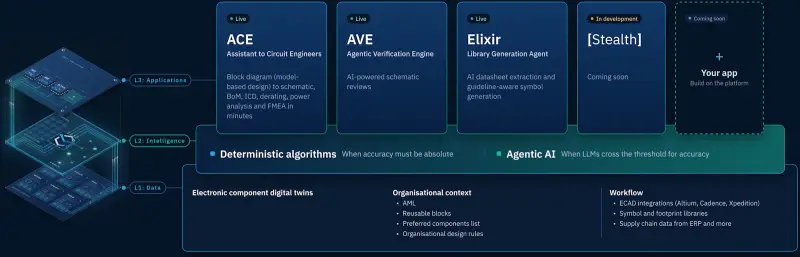
AVE sits within a platform that has three layers. At the base, the L1 data layer holds structured digital models of electronic components along with each customer’s organizational information and existing workflows. The L2 intelligence layer combines deterministic algorithms with agentic AI. The L3 application layer contains ACE, AVE and other applications.
One of those applications is Elixir, which extracts information from component datasheets and turns it into structured, machine-readable component data and schematic symbols. The output is prepared according to an organization’s internal design guidelines. Sharing a data and intelligence foundation gives these applications access to the same component knowledge and company-specific engineering information.
Choosing the method to fit the task
Circuit Mind’s approach to AI has changed as its product range has grown. The company initially used AI to extract information from datasheets and convert it into structured component models, then relied on deterministic, physics-based and mathematics-based algorithms to generate circuits. Adesanmi says the platform now uses both those methods and large language models (LLMs), combining them where appropriate for a task.
The distinction matters in engineering work. LLMs can produce useful results, but they can also present incorrect information confidently. That may be tolerable in a casual exchange; in an electronic design, a wrong pin assignment or misunderstood operating limit can have consequences that appear only during verification, prototyping or production.
Adesanmi describes the platform as using different methods “in the right place.” The approach does not rule out LLMs, or apply them to every problem by default. Instead, the choice depends on the work being done. For teams considering these tools, the important questions are how each result is produced, what data it relies on and how engineers can check it.

Designed around engineering organizations
Circuit Mind says it is focusing on professional electronics engineers at large companies. This emphasis recognizes that a design must satisfy more than its immediate electrical function. Organizations may require parts from preferred lists or approved manufacturers, use established supply chains, or follow internal conventions for schematic symbols, net names and component selection.
Those rules often reflect accumulated experience, manufacturing practices and lessons learned from earlier designs. Circuit Mind says customers can configure the platform to account for their own requirements. It also integrates with ECAD environments from Altium, Cadence and Siemens, allowing engineers to work with existing libraries and conventions.
This matters because two teams given the same design requirements may reasonably produce different circuits. Their component choices and implementation rules can differ, even when both designs meet the functional need. A design tool has to fit those local constraints to be useful in a real engineering process. Circuit Mind’s stated aim is to produce work that fits how a customer operates, as well as to automate parts of design and review.
The potential cost of missing an error also varies by product. A hardware problem found after a prototype may require a printed circuit board (PCB) respin, adding weeks or months to a schedule. Software issues can often be corrected after deployment through over-the-air updates or other patches; changing hardware already in customers’ hands can be much harder. For high-volume products, a fault discovered after shipment can also lead to a costly recall and damage to a company’s reputation.
Circuit Mind identifies aerospace, industrial electronics and high-volume consumer hardware among its primary markets. These fields place a premium on reliable, repeatable engineering work. The platform does not remove the need for engineers to verify and validate designs or to carry out appropriate testing. Its stated purpose is to help catch problems earlier and reduce the chance of errors reaching later development stages.
Reported results and next steps
The company names Emerson and Schneider Electric among its customers, while saying that some other large users prefer not to disclose their use of the tools. It also points to two reported evaluations. A peer-reviewed case study by the space electronics team at Los Alamos National Laboratory described completing a design task in four hours, compared with two weeks previously. Schneider Electric says early evaluations indicate the potential to reduce electronic architecture exploration effort by more than 90%.
These results describe specific cases and should be read in that context. They do not establish that every design will see the same reduction in time or effort. They do give engineering teams concrete examples to examine when judging where automated design and review might fit into their own work.
Circuit Mind also announced $25 million in financing, including an $18.5 million Series A led by Norwest and a previously unannounced seed round. The company puts its total funding at $33.4 million. It plans to use the financing to expand its engineering, sales and customer-support teams, establish a US headquarters, and develop the platform across more stages of electronic design.
Adesanmi said the company had 32 employees and planned to at least double that number before the end of the following year. Its hiring areas include electronics and software engineering, mathematics, AI, and sales and marketing experience in the electronics industry.
Further platform capabilities under consideration include design analysis, reporting, testing and potentially firmware development. PCB placement and routing are not currently included, although Adesanmi says the company may consider them in the future.
The direction is clear: Circuit Mind is applying AI and deterministic engineering methods to specific parts of the electronics workflow, while keeping experienced engineers responsible for the design and its verification. For engineering teams, the value will depend on how well the tools handle their component data, design rules and ECAD practices—and whether they surface useful problems early enough to avoid costly changes later.
 Choosing Single, Double, Welded Flap and Repair Keder for Fabrication
 MIG Transfer Modes: Choosing Between Short Circuit, Spray and Pulse
 CNC Steel Machining: Material Grades, Processes and Quality Factors