Tent Roof Panel Welding: Managing Hip Seams and Leak-Prone Intersections
Hip seams and intersections need close control of alignment, heat and inspection. Hot air and hot wedge welding suit different roof seam geometries.
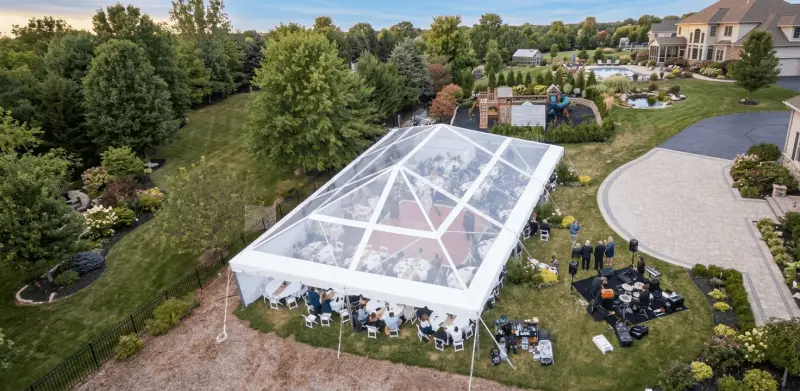
Hip seams and seam intersections are the demanding points in a multi-panel tent roof. Their angles and changing paths make alignment harder to maintain, while several welds and fabric load paths converge at intersections. A consistent roof assembly starts with accurate panel preparation, a welding method suited to the seam geometry, and quality checks that cover these complex areas.
Commercial tent roofs often exceed the width or shape that can be cut from a single roll of fabric. Manufacturers join multiple panels to form the finished roof, using controlled heat, pressure and movement to bond compatible materials. The fabric, seam design and production requirements determine which process and settings will work. Confirm material compatibility before setting up production; coated fabrics vary in their suitability for welding.
Why hip seams and intersections need attention
A hip seam follows the sloped part of a roof where adjoining panels meet. It may change direction or meet ridge and eave seams, unlike a straight sidewall run with a relatively consistent path. That geometry puts more demands on panel tracking and on maintaining consistent heat, pressure and travel speed. A small positioning error at the start can become more visible as the seam continues.
Intersections concentrate multiple weld paths in a small area. Fabric tension, movement and wind can load adjoining panels from different directions, making the load path more complex than along a straight seam. The tent design, fabric properties, reinforcement strategy and weld quality all affect how the area performs. These factors also make intersection inspection an essential part of production quality checks.
Several defects can compromise an intersection. Overlapping passes may leave areas without consistent fusion; excessive heat during multiple passes can damage or distort coated fabric. Misalignment and inconsistent bonding can contribute to separation under repeated flexing, while gaps may provide paths for water. These are risks to look for, rather than inevitable outcomes.
| Seam area | Production consideration | Potential concern |
|---|---|---|
| Straight sidewall run | Consistent seam path | Variation in heat, speed or pressure |
| Hip seam | Angled or changing geometry | Misalignment, puckering or uneven fusion |
| Seam intersection | Multiple weld paths meet | Incomplete fusion, excess heat, separation or leakage |
Matching the welding process to the seam
No single process suits every seam on every tent roof. Material compatibility, seam shape, output requirements and equipment capabilities all matter. Hot air and hot wedge welding can serve different parts of the same roof assembly.
Hot air welding directs heated air at the thermoplastic coating where the fabric layers meet; pressure then bonds the softened surfaces. Its maneuverability makes it useful where a welding path curves, changes direction or has other complex geometry, including many hip seams. The process depends on balancing heat, airflow, nozzle configuration, speed and pressure for the fabric and application.
Hot wedge welding uses a heated wedge in direct contact with the material at the seam interface, followed by pressure rollers. It can suit long, straight runs where the seam path stays consistent. Some roof designs may use wedge welding on straight sections and hot air around more complex geometry; the choice depends on the product and available equipment.
Radio frequency (RF) welding uses electromagnetic energy to form a weld in compatible materials. Continuous welding processes may suit long roof seams, while RF can be considered for applications where the material, tooling and seam design fit its process. Manufacturers need to select technology against the complete application rather than assuming one method works everywhere.
Building a repeatable multi-panel assembly
Process consistency begins before a panel reaches the welding equipment. A repeatable sequence helps reduce variation among panels, operators and finished roofs.
- Verify the panel layout and cuts. Check dimensions, orientation, identification and seam allowances. Cutting or positioning errors can accumulate as additional sections are joined and affect alignment farther along the roof.
- Align panels along the full seam. Position the material to the required configuration and check the entire planned path before welding. Guides, handling systems and operator procedures can help keep panels in place. Major alignment issues are difficult to correct once the fabric has been joined and may lead to wrinkles or puckering.
- Weld the primary hip seam. Maintain settings validated for the material and seam. With heat-based processes, that means controlling the relevant combination of temperature, speed, pressure and airflow or wedge temperature. Changes in coating, thickness, ambient conditions, machine setup or seam geometry may call for adjustment.
- Address the intersection. Check where the hip joins another roof seam. Depending on the design, material and engineering requirements, this area may need additional welding or reinforcement. The procedure should achieve the required bond without overheating the fabric. Requirements for PVC-coated fabric welding should be considered when that material is used.
- Inspect before final assembly or shipment. Look for uniform weld appearance and correct positioning, as well as wrinkles, gaps, damaged coating or incomplete fusion. Use destructive or nondestructive tests where appropriate to the manufacturer's quality requirements.
Validated process settings matter because the same machine conditions may not produce the same result across different fabrics or seam configurations. Keeping records of approved parameters helps production teams check whether a change in material or setup needs review.
Quality checks should include the difficult geometry
A sample from the middle of a straight seam can show whether the process is producing an acceptable bond under those conditions. It cannot establish how the weld behaves through a turn or where another seam crosses it. Inspection and sampling plans should therefore cover hip seams and intersections, not just accessible straight sections.
Depending on the product and internal procedures, a quality plan may include visual examination, checks that panels remain aligned after welding, pull or peel tests on representative samples, and water testing when appropriate. Inspect for gaps, coating damage, wrinkles and signs of incomplete bonding. Acceptance criteria should reflect the material, product design, engineering requirements and applicable standards.
Reinforced edges may need a separate process. For example, keder welding is used for reinforced tent edges. Edge treatments and roof seams contribute to different parts of the finished assembly and should be evaluated according to their intended function.
Equipment choices follow the production application
Tent production can combine long straight seams with curves, hems, reinforcements and multi-panel roof assemblies. Miller Weldmaster makes fabric welding equipment and describes solutions that can include hot air or hot wedge technology, guides, material handling, cutting and automation. The suitable configuration depends on the fabric, seam geometry, production rate and finished-product requirements.
Automated tent and structure welding systems can be configured around particular production needs. For manufacturers evaluating equipment, the useful starting point is the work the line must perform: which materials it handles, how the seams run, and where the assembly requires controlled positioning or additional operations. Equipment selection follows from those details.
What to carry into production
The number of panels in a roof varies with tent dimensions, design, available fabric width and construction method. Larger or more complex roofs generally require more panels and seams, increasing the importance of accurate cutting and alignment. Hot air can provide flexibility through curved or angled paths, while hot wedge can be effective on long, straight runs; neither choice removes the need to validate settings for the actual material.
For strength and weather resistance, test representative welds and include the places where geometry changes or seams converge. A roof can look consistent along its straight runs while still having defects at a hip or intersection. Manufacturers refining an existing process or considering automation can discuss their tent roof welding application with Miller Weldmaster.
 Choosing Single, Double, Welded Flap and Repair Keder for Fabrication
 Houston Engineering Team Builds a Welcoming Golf Tournament at East River 9
 MIG Transfer Modes: Choosing Between Short Circuit, Spray and Pulse