Ubiqedge Combines Modular IIoT Hardware with Edge and Cloud Software
Ubiqedge pairs configurable KLEON hardware with SAMASTH software, assigning local control to the edge and analytics and fleet management to the cloud.

Industrial IoT deployments often have to bridge equipment from different vendors, protocols and generations. Ubiqedge’s approach is to build both sides of that connection: KLEON, a configurable hardware platform, and SAMASTH, software for data, analytics and remote device management. The design’s practical distinction is where it places computing tasks: KLEON can store and process data locally and run control logic, while SAMASTH handles broader monitoring and fleet functions.

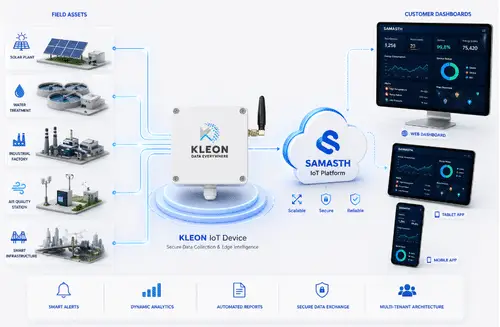
That split matters in facilities where connectivity can be intermittent or where a local process needs to continue without a live cloud connection. Ubiqedge says pump scheduling can run on KLEON even when internet access is unavailable. Cloud access adds a wider view across devices and sites, but the edge unit can retain a role in the operation itself.

Hardware configured for different equipment
KLEON is intended to connect to industrial assets such as energy meters, programmable logic controllers (PLCs), pumps, motors, controllers and environmental sensors. Instead of fixing every deployment to one gateway configuration, the platform can be adapted using different processors. The account of the system does not specify processor models or performance figures, so the choice of compute capacity for a particular installation remains a deployment detail.

Its listed connectivity options include 4G, Wi-Fi, LoRa, RF and Ethernet. For industrial communications, Ubiqedge lists Modbus RTU, Modbus TCP/IP and RS485. Those choices cover a mix of network links and equipment interfaces that can appear in the same plant or infrastructure project. They also give integrators several ways to connect assets, though the appropriate combination will depend on the equipment and site requirements.

In a conventional multi-vendor build, engineers may need to select a gateway, sensors, communications hardware and software separately, then make those pieces work together. That can offer flexibility through component choice, but it can also bring integration and customization work. Ubiqedge’s stated rationale for developing KLEON and SAMASTH in-house is to retain more control over how hardware and software are adapted for an application.
Local operation and shared visibility
SAMASTH collects and organizes data from KLEON and other systems. Its functions include dashboards, analytics, predictive analytics, alerts, reporting and remote device management. The system also supports two-way communication, including remote control of connected devices and firmware updates.

The division of work is a useful architectural choice. Local storage and processing can keep selected functions available at the installation, while cloud services can aggregate information, issue notifications and manage a wider device fleet. That arrangement can reduce dependence on continuous internet access for tasks assigned to the edge. The source does not describe the platform’s network security, data retention, update safeguards or failure recovery, so those details would need to be assessed separately for a specific deployment.


One platform across several sectors
Ubiqedge reports that its platforms are in use for solar monitoring, water management, air quality, railway infrastructure and ready-mix concrete applications. The company says more than 37,000 devices and assets have been deployed across India. Those figures indicate reported use at a substantial scale, although no breakdown by application or deployment conditions is provided.
The company also says its modular architecture can bring a new application to market in one to eight weeks, compared with nine to 18 months for conventional approaches involving off-the-shelf hardware or development from scratch. These are company-reported timelines; the account does not define how the periods are measured or what work each includes. The comparison is best read as Ubiqedge’s estimate of the time its reusable platform can save when adapting an existing stack.
The broader aim is to make KLEON and SAMASTH a shared foundation for applications developed by Ubiqedge and its channel partners. For engineering teams, the proposition is a configurable combination of field interfaces, local processing and cloud services that can be reused across different installations. The details that will determine its fit in practice are the processor options, supported equipment, integration effort and how responsibilities are divided between local operation and remote management.
 Choosing Single, Double, Welded Flap and Repair Keder for Fabrication
 Houston Engineering Team Builds a Welcoming Golf Tournament at East River 9
 MIG Transfer Modes: Choosing Between Short Circuit, Spray and Pulse