AMD, IBM and ORNL Link Quantum Processors with HPC for Error-Correction Research
A hybrid system pairs IBM’s 120-qubit Nighthawk with ORNL’s AMD-powered Umbra HPC to study quantum error correction and workflow integration.

Quantum computers need substantial classical computing support to investigate error correction, run simulations and coordinate system workflows. AMD, IBM and Oak Ridge National Laboratory (ORNL) are building a hybrid architecture that brings quantum processors and high-performance computing (HPC) resources together for this work. The initial configuration links IBM Quantum Nighthawk, a 120-qubit quantum computer, with ORNL’s Umbra HPC system.

The arrangement reflects a practical constraint in quantum research: a quantum processor does not handle every task involved in a computation. Classical processors and accelerators can take on simulations, optimization and the processing of error data, while software coordinates jobs across the two computing environments. The engineering question is how to divide those tasks and connect the hardware and software well enough to support research into larger, more useful quantum systems.

A combined platform for architecture and workflow research
The collaboration builds on a code-signing platform developed by IBM and the Quantum Science Center at ORNL. It brings quantum processors and HPC facilities into a shared environment where researchers can assess hardware architectures, software and workflows. That setup gives teams a place to study integration choices alongside the computing tasks they support.
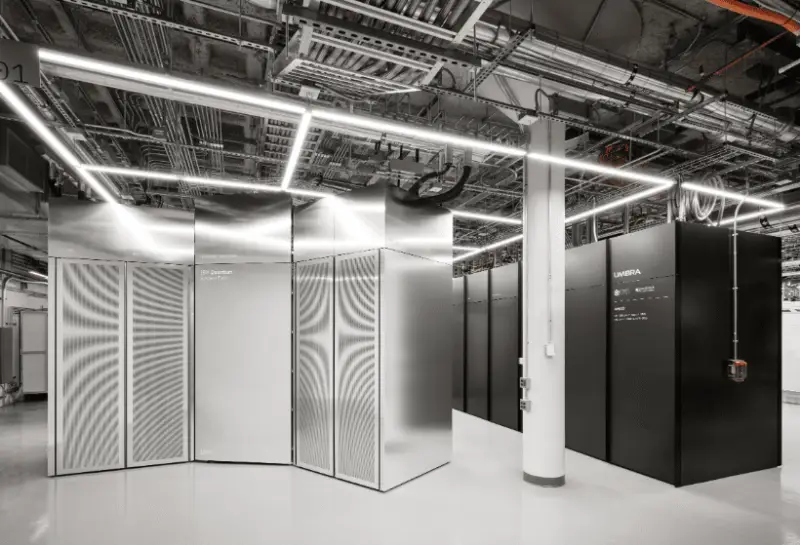
For the first implementation, the quantum side is IBM Quantum Nighthawk, specified at 120 qubits. Its classical counterpart is ORNL Umbra, equipped with fifth-generation AMD EPYC CPUs and Instinct MI355X GPUs. Together, these systems provide resources for research on quantum error correction, decoding optimization and software orchestration. The stated focus is the research platform and its integration; no performance results or error-correction benchmarks are specified.

Keeping the work within a shared platform matters because the computational demands vary. A workflow may need general-purpose processing for system management, GPU capacity for parallel calculations, and fast control or readout functions close to quantum hardware. Researchers can use the combined environment to explore how those jobs should be assigned and coordinated, rather than treating the quantum processor as a stand-alone machine.

Different processors, different roles
AMD EPYC CPUs handle general computing and workload management across the quantum and classical systems. Instinct MI355X GPUs are intended to accelerate simulations, optimization and parallel computation. These are complementary roles: CPUs can manage a broad mix of tasks, while GPUs can process many suitable calculations concurrently. The platform is designed to let researchers investigate how such resources contribute to quantum computing workloads.
AMD Versal adaptive SoCs add another layer. They are intended for fast control, processor readout and error decoding near quantum hardware. Proximity is relevant because some control and data-handling operations are closely tied to the quantum processor’s operation. The platform’s mix of CPUs, GPUs and adaptive SoCs gives researchers several types of classical hardware to evaluate against those requirements.

Software is the connective tissue. AMD’s ROCm open software ecosystem is part of the proposed link between the hardware and HPC and artificial intelligence applications. In a hybrid system, orchestration has to account for work moving between different processors and the quantum device. The practical value of the platform will depend partly on how well researchers can develop and run those workflows across the combined resources.

Error correction is a central workload
Quantum information can be affected by noise and computation errors. Detecting and correcting those errors requires classical processing alongside the quantum computation, including work to decode error data. That makes error correction a natural focus for a platform combining a quantum processor with CPUs, GPUs and adaptive hardware.
Decoding is not simply a matter of adding more quantum bits. It also calls for classical computation and software that can handle the associated data and coordinate the work. The joint environment gives researchers a way to examine those demands, test software orchestration and explore how hardware choices affect the overall architecture. The available details describe research aims, not a measured improvement in correction performance.
The work sits within the Quantum Genesis Mission initiative and is directed toward quantum computing with scientific relevance by 2028. The platform is also intended to connect in the future to the Leadership Computing Facility at ORNL. That planned connection would extend the system’s relationship with large-scale computing resources, though specific timing and technical arrangements have not been provided.
For engineers following quantum systems, the notable development is the effort to treat classical and quantum hardware as parts of one research architecture. Its near-term contribution is a shared environment for studying error decoding, simulations and workflow coordination. The next useful evidence will be how those studies translate into tested software and system designs, and how the planned connection to ORNL’s Leadership Computing Facility is implemented.
 Choosing Single, Double, Welded Flap and Repair Keder for Fabrication
 Houston Engineering Team Builds a Welcoming Golf Tournament at East River 9
 MIG Transfer Modes: Choosing Between Short Circuit, Spray and Pulse