ESP32-C3 Robot Mesh Uses WebSockets and Hand Gestures for Multi-Robot Control
An ESP32-C3 and browser dashboard connect battery-powered robots for individual or shared control, including commands mapped from hand gestures.
A browser dashboard can turn a group of small Wi-Fi robots into a shared control system: users can steer each unit separately or send the same movement command to several at once. The design combines an ESP32-C3, N20 geared motors, a DRV8833 motor driver, WebSocket connections and camera-based hand gesture recognition. Its value is as an accessible platform for exploring multi-robot control; the described build does not establish performance at the scale of hundreds or thousands of robots.

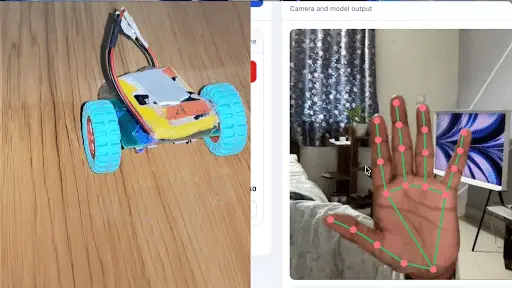
One dashboard, separate robot connections
Each robot connects to a browser-based web application over Wi-Fi using its own WebSocket address, given in the form ws://ROBOT_IP:81/ws. The dashboard lets an operator add nodes by entering their IP addresses and establishing individual connections. That arrangement keeps the robots addressable as separate devices while allowing commands to be sent to one node or several connected nodes together.

WebSockets suit this kind of interactive control because they keep a connection open for two-way communication between the browser and a robot. Rather than treating every movement as a separate page request, the dashboard can send a command over the existing connection. The project describes this as real-time control, though it gives no measured latency, update rate, range or maximum node count. Those figures would matter when judging how well the setup handles faster motion or a larger group.

The dashboard offers directional controls for moving forward, backward, left and right, as well as rotation and stop commands. These buttons provide a direct way to test a single robot or operate several at once. Individual control remains available for situations where the units need different movements; shared commands are useful when the goal is to make multiple robots follow the same input.

Gesture recognition adds another input path
The second control method uses a camera to capture hand movement. MediaPipe Hand Landmarker recognizes predefined gestures, which the application maps to movement commands and sends through the selected robots’ WebSocket connections. A gesture can therefore trigger a shared movement across several connected units, while the dashboard still supports per-robot commands.
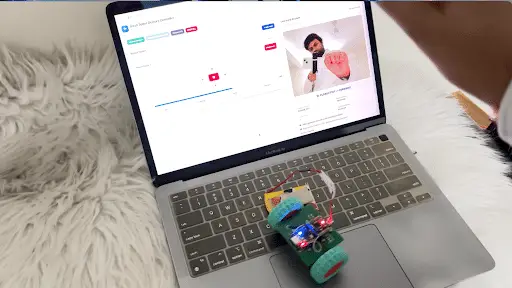
This control chain has distinct stages: camera input, hand landmark detection, gesture interpretation, command mapping and wireless delivery. Keeping those stages in view helps when diagnosing unexpected movement. For example, a recognition mistake and a dropped Wi-Fi connection can both prevent the expected response, but they point to different parts of the system. The project description doesn’t specify the gesture vocabulary, camera requirements, recognition accuracy or what the application does when it loses a connection.
Hand control offers a different interface from directional buttons, but it doesn’t remove the need for clear command handling. Operators need to know which robots are selected and whether a gesture will affect one unit or a group. The design’s combination of individual addressing and group control makes that selection part of the practical user experience, especially as more nodes are added.
Compact hardware, expandable experiments
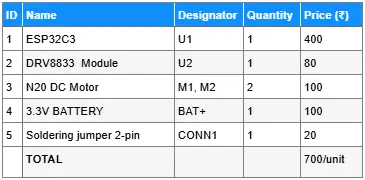
The mobile robot uses an ESP32-C3 microcontroller and N20 geared motors. A DRV8833 dual H-bridge motor driver interfaces the controller with the motors, allowing the firmware to control their direction. The build is battery-powered, and its firmware is developed with the Arduino integrated development environment. The project also describes the unit as miniature, but supplies no dimensions, battery capacity, operating time, motor speed or payload figures.

Those missing specifications limit what can be inferred about the robot’s operating envelope. Battery life and motor performance, for instance, depend on the chosen battery, mechanical load and operating conditions; none are quantified here. The design is presented as a small experimental platform rather than a characterized mobile robot, so builders would need to evaluate those factors for their own hardware and use.
The stated bill-of-materials comparison is ₹700 per unit to build versus ₹5000 to buy a mini AI robot for learning. These are the figures given for the project’s comparison; no itemized parts list or details of what the purchased robot includes are provided alongside them. The figures therefore offer a headline cost comparison, not a full accounting of development time, tools or differences between the two systems.

Where the architecture may lead
The current design controls basic mobile robots, not robotic arms. Its broader appeal is the control pattern: a web interface maintains connections to multiple nodes, translates user input into commands and can direct one or several machines. That pattern can support classroom demonstrations, laboratory experiments and trials of coordinated movement, provided the hardware and software are adapted to the task.
Extending the idea to robot arms would require more than replacing wheels with joints. The project frames arm replication as a possible future application, but gives no arm design, motion mapping, positioning accuracy or safety behavior. A gesture that works as a simple direction command for a mobile robot doesn’t, by itself, define how a multi-axis mechanism should move.
For engineers and makers, the useful takeaway is the division of responsibilities: the ESP32-C3 handles each robot’s local motor control, while the browser provides the shared interface and gesture processing. The next meaningful measures would be connection reliability, response delay, behavior after a node disconnects and the number of robots that can be controlled without confusing the operator. Until those are reported, this is best read as a flexible learning and prototyping setup, with its real scaling limits still to be tested.
 Choosing Single, Double, Welded Flap and Repair Keder for Fabrication
 Houston Engineering Team Builds a Welcoming Golf Tournament at East River 9
 MIG Transfer Modes: Choosing Between Short Circuit, Spray and Pulse