Arcfox Adds CATL Battery Swapping to Beta T1 and Beta S3 EVs
Arcfox’s swappable Beta models lease their CATL batteries and use a network designed for pack changes in about 99 seconds.

Arcfox’s new Beta T1 and Beta S3 swap editions make battery ownership a separate part of buying an electric car. Customers purchase the vehicle without its battery, then lease a compatible pack through CATL’s Choco-Swap service. A swap takes about 99 seconds, shifting the wait for charging toward access to a suitable station and a leased battery plan.

BAIC’s Arcfox brand has introduced the two models in China. The Beta T1 starts at 52,000 yuan, with its top trim priced at 60,000 yuan. The Beta S3 535 Ultra+ LiDAR Swappable Edition has a limited-time subsidised price of 78,800 yuan under the leasing scheme. These prices are tied to the battery-leasing approach; buyers should assess the recurring lease cost alongside the vehicle price.

Lease terms set the running cost
For a monthly fee of 399 yuan, the lease plan includes 5,000 kilometres of driving. An unlimited-distance option costs 599 yuan per month. Buyers are also offered 20 battery-swap vouchers covering a total of 10,000 kilometres of swapping mileage. The promotion applies to Beta S3 swap-edition purchases made by January 31, 2027, and to Beta T1 buyers.
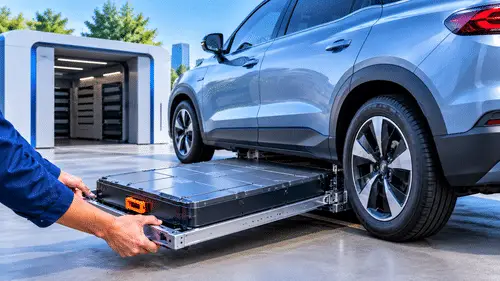
The scheme changes the purchase calculation: the quoted car price does not include ownership of the energy storage pack. The lease fee and the swap network become ongoing parts of vehicle use. The available information gives the monthly prices and mileage allowance, but does not describe other lease conditions, such as how a depleted pack is assessed or what happens at the end of a lease. Those details matter to buyers comparing the arrangement with a conventional EV purchase.

Performance and range claims differ by model
The Beta S3 uses a 159 kW electric motor rated at 250 Nm. Arcfox lists a 0–100 km/h acceleration time of 7.1 seconds and a maximum speed of 165 km/h. Its stated range is 535 km under China’s CLTC test conditions. The vehicle also includes a 192-line LiDAR sensor and a Horizon Robotics Journey J6M chip for its driver-assistance system.

The Beta T1 is specified with a 95 kW motor and a maximum speed of 150 km/h. Its swappable version is claimed to travel 530 km under CLTC conditions and uses a 54 kWh CATL lithium iron phosphate (LFP) battery. Battery chemistry and capacity are given for this model; equivalent pack details for the Beta S3 are not included in the available specifications.
Arcfox’s regular T1 website lists a 30% to 80% charging time of 16.9 minutes. That figure applies to the regular model and shouldn’t be treated as a charging specification for the swappable T1. The 99-second claim describes the time to exchange a battery pack, not to recharge one. It therefore measures a different part of the energy replenishment process than a fast-charging time.

Station coverage is the practical constraint
CATL’s Choco-Swap system is the common infrastructure behind the two vehicles. BAIC Group, CATL and CAES signed a collaboration agreement on 25 April 2026 covering compatible vehicle development, swap infrastructure and battery life-cycle management. CATL said at the time that its network had more than 1,470 stations across 99 Chinese cities, with a target of more than 3,000 stations in almost 190 cities by the end of 2026.

For drivers, station coverage determines whether a brief exchange time translates into a useful reduction in travel downtime. A 99-second swap is meaningful when a compatible station is nearby, has a suitable pack available and can serve the vehicle. The network count and expansion target describe CATL’s reported footprint and plan; they don’t establish availability on every route or at every location.
The engineering proposition is straightforward: standardise the vehicle and pack interface around a swapping network, then let drivers exchange a discharged battery for a charged one instead of waiting for the vehicle to charge. That approach depends on compatible hardware, station operations and pack availability, while leasing separates the battery cost from the vehicle’s initial price. Arcfox’s figures make the time and pricing model clear; station access and the full lease conditions will determine how practical it is for individual drivers.
Arcfox lists further details for the T1 on its model page.
 Houston Engineering Team Builds a Welcoming Golf Tournament at East River 9
 MIG Transfer Modes: Choosing Between Short Circuit, Spray and Pulse
 TI India’s 40-Year Engineering Hub: From Chip Design to Complete Products