Consumer Asset Trackers Could Reach 31.4 Million Devices in Europe and North America by 2030
Berg Insight forecasts 13.4% annual growth as pet, child and vehicle trackers expand, with battery life and connectivity shaping product design.


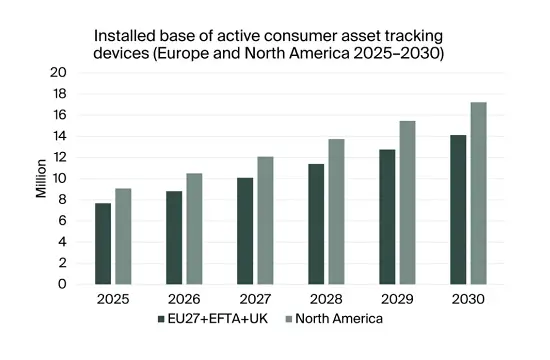
Consumer asset tracking is moving beyond a niche market, but the opportunity depends on more than adding GPS to everyday objects. Battery life, coverage, device size and useful software all shape whether a tracker fits its job. Berg Insight counted 16.8 million active devices across Europe and North America at the end of 2025 and forecasts 31.4 million by 2030.
The forecast represents a compound annual growth rate of 13.4%. Berg Insight expects the corresponding market value to rise from €2.3 billion in 2025 to €4.2 billion in 2030. Those figures include connected products and their associated services, reflecting a market in which recurring connectivity and software can matter alongside the hardware.
Low adoption leaves room for growth
The report’s fourth edition describes a large potential customer base relative to current tracker use. Europe and North America together have more than 380 million dogs and cats, approximately 620 million passenger cars, 160 million other consumer vehicles and nearly 70 million children aged 4–10. That last group is a primary market for GPS-enabled watches.
Despite those potential applications, Berg Insight puts the overall penetration rate for GPS tracking products at approximately 1.2%. Pet trackers, children’s GPS watches and passenger car tracking solutions currently account for the largest active-device segments. The low rate suggests considerable room for adoption, though it does not guarantee that every category will grow at the same pace.
The market figures have a specific scope: they cover devices that use wide-area connectivity, including cellular, satellite, LoRa and Sigfox networks. Bluetooth-only and Wi-Fi-only products, such as conventional proximity item trackers, are excluded. That distinction matters when comparing this forecast with broader counts of consumer location products. A tracker with its own wide-area connection can report location over greater distances without relying on a nearby phone or local wireless network.
Different uses call for different products
Pet tracking is led by specialized providers. Austria-based Tractive has approximately 1.8 million subscribers, while Fi and Halo are prominent North American players. In this category, a small, wearable device must balance location reporting with the weight and battery capacity a pet can comfortably carry. Tractive’s subscriber count also illustrates that the service attached to a tracker can be an important part of its business.
Family and child tracking draws on a different mix of suppliers. Smartcom Mobility Solutions and Smith Micro Software provide platforms and white-label services, while Xplora Technologies and US mobile operators serve the children’s smartwatch market. A watch combines location functions with a device worn throughout the day, so its size, battery requirements and service model differ from those of a tracker mounted on a vehicle.
Vehicle tracking spans passenger cars, motorcycles and bicycles. North American providers include Passtime GPS, Tail Light’s Bouncie and Agnik; European suppliers include Net4Things, Air and CarLock. Monimoto and GeoRide focus on motorcycles, while Bosch eBike Systems, PowUnity and IoT Venture operate in bicycle tracking. The variety of products reflects practical differences in installation, power availability and where a vehicle is used. A tracker for an e-bike, for example, has to fit within the constraints of a bicycle system, while a car product can be designed around a different installation and power arrangement.
The sector has also seen acquisitions as companies seek scale and broader service offerings. Tractive acquired Whistle Labs in 2025, and Bending Spoons acquired Tractive in 2026. These transactions point to consolidation among providers serving distinct consumer tracking categories.
Connectivity and power shape the engineering
For device makers, maintaining useful operating life is a central design constraint. Many trackers are compact and battery-powered, whether attached to a pet, bicycle or personal item. More frequent location updates can increase power demand, while a smaller enclosure limits the battery that can fit inside. Product design therefore involves matching reporting frequency, network choice and battery capacity to the intended use.
Low-Power Wide-Area networking technologies can help address applications where long operating life and wide-area communication both matter. Satellite connectivity may complement cellular networks in places with limited terrestrial coverage. These options broaden where a tracker can work, but the appropriate architecture depends on the service’s coverage needs and the device’s power budget.
Software is also expanding the role of some trackers. In pet products, AI-supported health and activity monitoring can add information about animal behaviour and wellbeing to location data. That gives providers a way to offer more than a point on a map, though the usefulness of those features depends on what the device can measure and how clearly its service presents the results.
The practical takeaway is that tracking products need to be designed around specific tasks. Positioning performance alone won’t determine whether a device works well: battery autonomy, network availability, size and the value of its software services all count. System integrators and platform providers must also accommodate different connectivity approaches and service models across pets, children and vehicles. Berg Insight’s forecast signals a larger market ahead; turning that growth into useful products will depend on solving those day-to-day design trade-offs.
Further details are available in Berg Insight’s Consumer Asset Tracking Solutions report brochure.
 Choosing Single, Double, Welded Flap and Repair Keder for Fabrication
 Houston Engineering Team Builds a Welcoming Golf Tournament at East River 9
 MIG Transfer Modes: Choosing Between Short Circuit, Spray and Pulse