Autodesk’s AI Strategy Connects Project Context, Design Agents and Local Models
Autodesk is building an agent led Assistant around project context, while workstation demos show firms can run design workflows locally.

Autodesk’s AI strategy is moving beyond features that speed up individual CAD tasks. At Autodesk University 2026, the company described a connected Assistant that can interpret a project request, select tools across its software, and return work for people to review. The proposal puts Autodesk’s project data and workflow history at the center; demonstrations on the Expo floor showed that firms are also exploring local models to control data access and compute costs.

CEO Andrew Anagnost called the broader effort “Project Intelligence”: a connected system that brings project data, decisions and disciplines together, and builds context as work progresses. The shift is significant for engineering teams because it changes the software’s role. Instead of navigating products and commands to complete each step, users would describe the outcome they need and let an agent coordinate relevant operations across Autodesk tools.
Assistant becomes a cross product agent
Autodesk plans to offer its Assistant as a standalone, agent led experience that can reach across products. Mike Haley, senior vice president of research, said it is intended for work that does not fit neatly inside Revit, AutoCAD or Fusion. The product is still in development and Autodesk expects it to launch next year.
The standalone version is intended to complement the assistants embedded in Autodesk applications. Amy Bunszel, executive vice president of AEC solutions, said the company will continue developing those in product tools. The distinction is that an embedded assistant can help within one application, while the standalone experience is meant to coordinate work spanning projects, products and disciplines.
Autodesk describes the likely audience through what it calls “critical user journeys”: tasks customers need to complete across products and projects. That could include experienced specialists who know the software well, as well as people who need to request an outcome without knowing which tool or workflow can produce it.
Under the interface, Assistant is expected to connect several kinds of technology. Bunszel named Model Context Protocol (MCP) connections, Autodesk built agents, agents supplied by customers, and cloud services available through Autodesk Platform Services (APS). The goal is a route into different capabilities without requiring the user to assemble each connection manually.
The name “Assistant” understates the scope shown at the event. The demonstration suggested a system that could launch agents, work across datasets and products, and produce a task specific interface. Autodesk is positioning this layer as part of its industry clouds: Forma, Fusion and Flow.
Project context is the differentiator
Autodesk argues that design work needs more than a general purpose language model connected to software commands. Geometry, engineering intent, schedules, materials, simulations and project history all matter. Haley said teams cannot rely on language models alone because design context is more than text: it includes geometry, intent, and the relationships and decisions that shaped the work.
The company has given this project specific information layer a name: Autodesk Context. CTO Raji Arasu said it is built from the decisions an organization makes, rather than drawn only from a prompt or isolated data source. Its purpose is to capture why a change happened, not just record that it happened.
Arasu illustrated the problem with a familiar project question: months after completion, why was a wall moved? A model may show the final geometry and perhaps a history of changes, but the reasoning can remain with the people who made the decision. Context is intended to preserve that reasoning alongside the relevant constraints, data, participants and workflow state.
Timing is part of that record. Arasu said context should represent the conditions in place when a decision was made, rather than just its timestamp. She described it as a map of how project information, people, decisions and activities connect.
Because projects span systems, Autodesk is developing Assistant Builder, currently in preview. It allows organizations to connect their own AI systems and those of their partners to Autodesk Assistant. The idea is to extend the assistant’s reach into tools and data beyond Autodesk’s own applications.
A second layer, Autodesk AI Orchestrator, is intended to select models for different tasks. Haley said it weighs accuracy, speed, security and cost. Arasu described a system that can route work to one model or several, drawing on Autodesk models, frontier models and open weight models.
Autodesk says customers should not have to benchmark every model against every workflow themselves. The orchestration layer is meant to handle that selection. The technical challenge is that design tasks vary: a geometry operation, a schedule query and a simulation do not necessarily benefit from the same model or processing approach.
Smaller models and neural CAD
Anagnost argued that large general purpose models can be an expensive way to handle narrowly defined engineering tasks. He said such models consume tokens rapidly when a constrained problem must be translated into repeated requests. Autodesk’s own models, once described as large, are now medium or small by comparison, and the orchestration layer is designed to use them where they fit.
Anagnost characterized the cost of running Autodesk’s narrower models as pennies compared with dollars for some larger model calls. He also said a model trained for a more specific task can produce more accurate results probabilistically. Autodesk is adding open weight models to its selection because, for certain tasks, Anagnost said their performance matched the best model from Claude.
Neural CAD is Autodesk’s umbrella term for generative models focused on geometry, design and manufacturing, and architecture, engineering and construction (AEC). It is not one model today. Tonya Custis, senior director of AI research, said individual neural CAD models are already used in Fusion, Revit and Forma, generally alongside other models.
The longer term research goal is to train a single model across those tasks. Custis said a model that learns multiple tasks together could improve across them. That remains a development objective; the current products use separate task models and supporting systems.
Sketch, speech and interfaces shaped around a task
Autodesk’s R&D team presented Project Quill, an experimental interaction that combines sketching, speech and AI. A rough drawing can express a shape that is difficult to describe, while spoken instructions can quickly specify a change that would be awkward to draw. Users can mark up a sketch and request edits such as enlarging a door or placing solar panels, then develop the result into a 3D object.
The system is intended for iteration rather than a single prompt followed by a finished design. Users could refine the output repeatedly, which matters in design work where the first interpretation is often only a starting point.
Autodesk is also considering interfaces that adapt to a task. Michelangelo Capraro, distinguished experience architect, said a user might ask Assistant to generate an interface for a particular operation in Revit. That could make complex software easier to approach by presenting only the controls relevant to the task at hand.
What the Assistant demonstration showed
The stage demonstration sketched how cross product coordination might work. It began with a project manager facing a backlog of emails, requests for information and issues. Agents assembled a prioritized view of items across projects.
In one residential project, a client wanted additional rentable area by moving a wall three feet. The project manager asked how the change would affect the schedule and what downstream impacts might follow. Assistant returned a Gantt chart highlighting schedule pressure points.
An architect then requested a Level of Development 300 apartment with walls and doors. Assistant called an industry foundation model trained to understand and generate building geometry, using Building Layout Explorer to stream a 3D model. The system placed room layouts into units with different shapes and dimensions. Autodesk presented this as work that could take minutes rather than a day.
The workflow next used Assistant Builder to run a slatted facade process from dimensions in an attached image. Assistant extracted measurements from a sketch and generated metal brackets for the wooden slats.
That work then crossed into Fusion. A design engineer received the specification, and Assistant located a similar bracket in an archive and updated it. The demo also generated more than a thousand fascia options from images before packaging the results for the architect.
These examples point to Autodesk’s intended division of labor: people define the outcome and judge whether it is acceptable, while agents locate the relevant tools, data and operations. The practical value will depend on whether the system can preserve project constraints and make its intermediate decisions clear enough for engineers to check.
Cost visibility and model choice
Predictable AI costs are a concern for firms testing agent based workflows. Anagnost said Autodesk expects to average costs across customers and tasks: some users may pay more than the compute cost for a simple operation, while others pay less for a complex one. The company expects the average to support a sustainable service.
Predictability does not automatically show an individual firm what it is paying for. Asked whether Autodesk might provide a pricing approach comparable to generative image services that show a cost per operation, Bunszel said that was realistic. She said expensive features would likely have a rate table so customers could see what happens when they invoke them.
Bunszel said routine AI capabilities should be included in subscriptions, with separate charges reserved for features that are particularly valuable or expensive to run. The company has not provided a detailed pricing schedule for the planned standalone Assistant, so customers do not yet have enough information to estimate costs for specific agent workflows.
MCP opens routes beyond Autodesk’s cloud
MCP provides a way for external language models to interact with software. Autodesk has developed MCP servers for Revit, Fusion and other products, and third parties have built their own connections. Nvidia’s Sean Young described another route: developers can write a server for an application when an API is available.
That flexibility gives firms more control over how they connect tools and where model processing takes place. Young warned that agents can use tokens quickly because they may spawn multiple subagents. At some scale, he said, cloud token charges can exceed an IT budget.
Kevin Philips of Symetri said local hardware is becoming attractive to AEC firms. He estimated that the most active five percent of developers could spend as much as $10,000 a month on tokens, while some practices are not allowed to use frontier models at all. Autodesk’s Bunszel said firms running open weight models locally is a positive option, and acknowledged that organizations may manage some workflow steps themselves while using Autodesk for others.
Local AI on workstations
At the more accessible end of the local AI demonstrations, HP paired its ZBook Ultra G3a mobile workstation with Perplexity software. The machine has 192 GB of system memory, with up to 160 GB available to the integrated GPU through the AMD Ryzen AI Max Pro system on a chip. That memory capacity allows the demo’s CAD and AI stack to run on one machine.
Perplexity acted as the orchestrator, using its own language model, a post trained version of Qwen, to drive the official Revit 2027 MCP server locally. Daniela Miranda-Smith of Perplexity said that with local models, the direct operating cost is electricity.
Greg Schleusner, formerly director of design technology at HOK, has tested the same workstation with more involved production workflows. He described running large models, or several smaller models working together, on the device. His examples included an LLM setting up Revit projects, machine learning based real time clash detection, and an image model checking room contents against requirements.
Schleusner said local hardware matters to firms concerned about sending data outside their own environment. On premises processing can also give organizations more control over the models and workflow connections, though the performance and capacity available will depend on their hardware and model choices.
Nvidia demonstrated a different local setup on Dell hardware. A Dell Precision laptop connected over Ethernet to a Dell Pro Max with GB10, a compact desktop powered by Nvidia’s GB10 Grace Blackwell superchip, which combines an Arm based Grace CPU and Blackwell GPU on one silicon die.
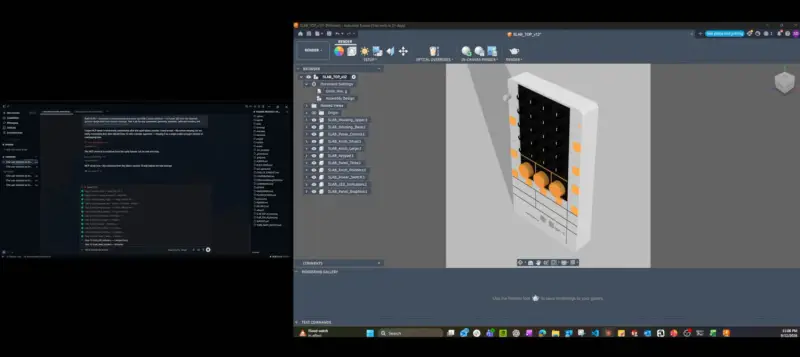
Revit, Fusion and custom MCP servers ran on the laptop, while the open weight Qwen3.6-27B model ran on the GB10. In the Revit demonstration, a third party MCP connection used a prompt to create a basic building. It was a proof of concept, but it showed a potential advantage of open weight models: firms can fine tune them with their own Revit data, an option unavailable with a frontier model.
The Fusion demonstration used multiple agents in a longer design process. The agents ran through the Hermes harness from Nous Research, which supports MCP and can connect to different models, including the local model on the GB10.
A project manager agent first read a product brief and analyzed two concept images, then divided the work among specialist agents. A CAD agent built the model in Fusion’s Design workspace, organized components, assigned initial materials and properties, and checked dimensions against the requirements.
A visualization agent set the camera, lighting and rendering properties, then compared the render with the concept images. It adjusted the materials and scene in a feedback loop before passing the approved model to a drawing agent. That agent generated 2D engineering drawings and a parts list, checking views, dimensions, annotations and list completeness. The project manager agent reviewed the outputs.
The demonstration was not evidence of a production ready autonomous design system, but it showed why multiple agents can be useful: one can check the work of another, and feedback can send a model back for correction. Young described a related pattern in which an agent builds geometry, runs two types of finite element analysis, and loops back to revise the geometry if a simulation finds a problem.
AI on hardware firms already own
Lenovo’s Civil 3D demonstration required no new high end AI system. It used a custom agent interface to calculate cut and fill volumes on a ThinkStation Ultra with a 16 GB Intel Arc Pro B50, a class of GPU already found in some firm workstations. Lenovo said agents could run on different workstations across a network and be called by users when needed.
That approach may be relevant to teams that want to test agent workflows without buying dedicated servers or relying on cloud inference. It also shows that local deployment can be distributed across existing machines, although the demo did not establish how the approach performs under larger production workloads.
Licensing remains a practical constraint
Local agents raise questions about how software vendors charge for their products. Autodesk Platform Services offers a Revit Automation API that runs the Revit engine in the cloud to create, extract and modify model data. If equivalent work is handled entirely on local machines, Autodesk could receive less usage based revenue from that service.
There is also a question of licensed seats. If agents handle bulk modeling, queries and documentation that previously required a person working in an application, a firm could need fewer seats to complete the same work. Agent systems that drive applications through MCP without interacting with the graphical interface may extend that change across several products.
Autodesk said customers can run multiple Revit instances on one workstation, provided each instance is properly licensed and users are signed in. The company also said its public MCP lets customers create agent workflows for internal business use. Developers building commercial applications can use APS.
Those statements give firms a basis for internal automation using Autodesk’s own MCP, but third party connections may raise different questions. Licensing terms and cloud service charges should be part of workflow planning, especially when an agent runs many instances or bypasses services that would otherwise be billed by use.
Fusion adds task specific AI features
Autodesk also outlined several AI capabilities planned for Fusion, focused on imported geometry, assembly setup, product configuration, design reuse and manufacturing preparation.
AutoTimeline is a feature recognition tool that converts imported geometry into editable parametric parts. It attempts to reconstruct the modeling sequence behind a shape, giving engineers more control over later edits. Autodesk sees potential use when teams work with supplier or contractor data, or move projects from other CAD systems.
AutoAssemble is intended to turn imported components into usable assemblies. The system recognizes parts, predicts their positions and creates the corresponding assembly relationships.
Fusion Assistant is planned to generate product configurations from natural language requirements. Autodesk says it will build the configuration logic needed to produce valid variants, potentially allowing teams to create hundreds of configurations through conversation.
Assistant is also intended to help teams reuse existing engineering data. It can search company libraries using geometry and metadata, identify released alternatives, surface active change orders and help replace components when an existing design fits better than a new one.
Find Similar uses industry foundation models to identify related components beyond part number searches and basic geometric comparisons. The feature is aimed at surfacing possible alternatives already present in a firm’s design data.
Autodesk is also developing AI generated CAM programming to automate machine setup, toolpath generation and production preparation. The intended workflow is to create reusable manufacturing automations rather than repeat the same setup steps for every job.
Inventor is set to become the first Fusion Connected Client. The connection is intended to link desktop engineering work in Inventor with cloud data and processes in Fusion, supporting a broader product lifecycle workflow.
The strategic question is context
Autodesk’s ambition is to shift value from individual tools toward completed outcomes. The standalone Assistant would decide how to approach a task across products, while Autodesk Context would give it a record of project decisions and relationships to draw on.
Local demonstrations show that firms can build capable workflows with open weight models, MCP connections and workstation hardware. They also offer a way to keep sensitive project data within a firm’s environment and to tune models on internal data. Those benefits come with their own planning needs: compute capacity, workflow reliability, software licensing and ongoing maintenance all matter.
Autodesk’s strongest argument is that generating geometry is only one part of design work. Coordinating project history, decisions, constraints and discipline specific data may be harder for a general model to reproduce. Whether firms want Autodesk to manage that layer will depend in part on transparency: customers need to understand what a workflow costs and what control they retain over their data and models.
The next generation Assistant is expected next year, giving engineering teams time to assess cloud and local approaches. With AI capabilities and costs changing quickly, technology leads will need to evaluate not only what an agent can produce, but also how it reaches that result, what it consumes and how its output fits the firm’s existing engineering process.
 Choosing Single, Double, Welded Flap and Repair Keder for Fabrication
 Houston Engineering Team Builds a Welcoming Golf Tournament at East River 9
 MIG Transfer Modes: Choosing Between Short Circuit, Spray and Pulse