MassRobotics Startups Explore ADI’s Robotics Engineering and Commercialization Support
Eight robotics startups met ADI’s investment, sales and engineering teams to discuss support from prototype development through production readiness.
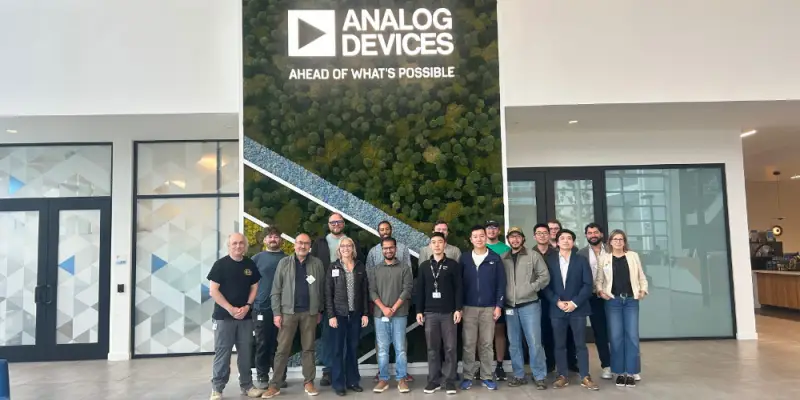
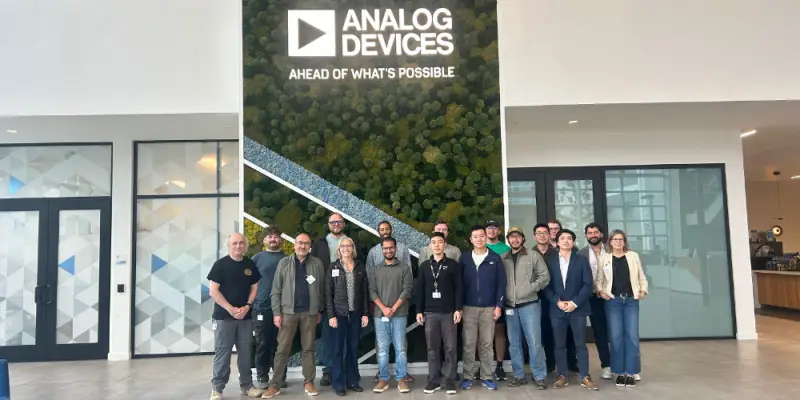
For a robotics startup, getting a prototype to work is only one part of the job. Turning it into a product that can be built, supported and sold at larger scale brings a different set of technical and commercial demands. MassRobotics’ October 22 visit to Analog Devices’ Emerging Tech Hub in San Jose put startup founders in direct contact with teams that work on those demands.
The open house brought eight MassRobotics startups to ADI’s co-creation space. The group covered areas including tactile sensing, smart materials, autonomy and Physica AI. The startups named were Contactile, RasLabs, P!ng, Saro Robotics, Vizi AI, Gitinama and Hardhat Robotics. The program was intended to make ADI’s available engineering expertise and business resources more accessible to early-stage companies.
ADI is a strategic sponsor of MassRobotics. Colm Prendergast, head of the Emerging Tech Hub at Analog Garage, committed to making engineering services and domain expertise available to MassRobotics startup residents. The visit gave founders a chance to see how that support might work, and to identify the right contacts for their needs.

Two difficult transitions for robotics companies
ADI framed robotics commercialization as a two-stage challenge. The first transition takes a company from a working prototype to early adopters. The next moves a product from those initial users toward the early majority, where hardware companies face the demands of repeatable production and wider deployment.
That framing matters because a demonstration alone doesn't establish that a system is ready for customers. A robotics product may need further work on its sensing, controls, power, integration or production design as it moves from a proof of concept to broader use. ADI’s view is that it can support companies at both transitions: helping with minimum viable products and proof-of-concept work early, then with product development as companies prepare to scale.
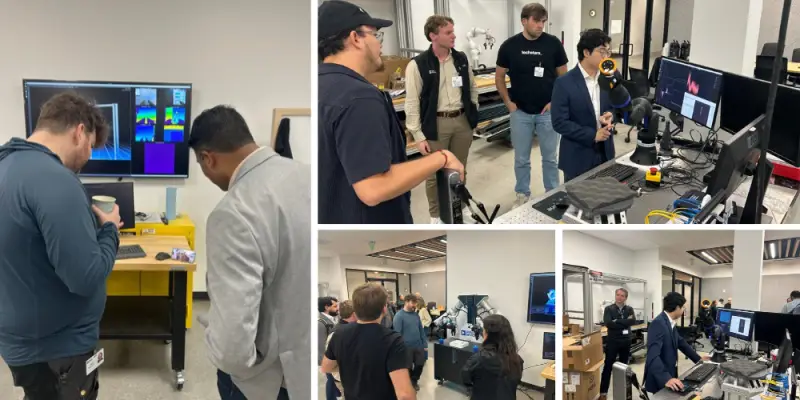
Founders met with three groups in rotating 30-minute sessions. ADVentures, ADI’s corporate venture arm, and Analog Garage discussed development and investment pathways. ADI’s sales and robotics business unit teams covered components and design support. The Emerging Tech Hub led a tour of its robotics lab and demonstrations. A closing discussion let founders share what they had learned and give feedback to ADI.
Four ways to work with ADI
The open house introduced four engagement routes, each tied to a different ADI team:
- Vendor: The robotics business unit and sales teams supply components and design support.
- Partner: The Emerging Tech Hub works directly with startups on technical challenges.
- Joint development: Analog Garage explores opportunities to develop technology together.
- Investor: ADVentures invests in early-stage companies working at the intersection of physical and digital systems.
For a founder, the practical point is that a large company can offer several kinds of help, and those offers come from different teams. Component selection and design assistance, hands-on engineering, co-development and investment each call for a different conversation. Knowing which need is most immediate can help a startup find a useful entry point.
From idea to production readiness
The Emerging Tech Hub is part of ADI’s Analog Garage and focuses on technical and commercialization gaps for robotics companies. The Robot Report describes the Hub as connecting startups and established robotics companies with ADI technical teams, including engineers working with recently released and in-development technologies.
ADI describes the Hub’s work across four stages: idea, prototype, validation and scale. At the idea stage, a team can clarify its goals and possible development path. Prototype work brings expert guidance into early builds and tests. Validation focuses on checking performance, refining the design and reducing technical risk. Scale preparation addresses production readiness and the steps needed to move toward manufacturing.
Resources span engineering expertise in robotics, controls, edge AI, power and system integration; development facilities and tools, including rapid prototyping, test and validation resources, and reference designs; and preparation for sourcing and production, with connections across the industry. The specific mix depends on what a startup needs. Engagement can be a short advisory discussion, extended technical support or full co-development.
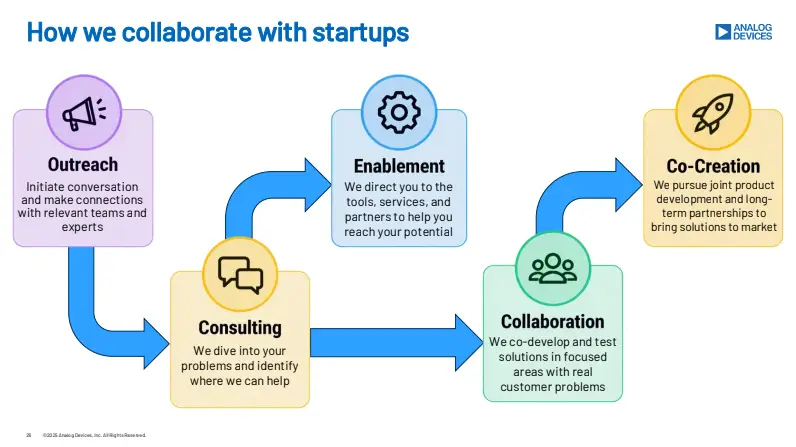
The process begins with outreach and consulting to understand a company’s challenges. The Hub can then direct the team to relevant tools, services and partners, work with it on customer challenges, or explore joint product development. Cameron Villone of the Hub describes co-development as starting with an assessment of a company’s current capabilities and goals, then aligning them with the Hub’s mission. The model is designed to let startups retain their intellectual property and shape the engagement around how they work.
Seeing sensing choices in a robot task
The lab tour included a proof of concept first built for NVIDIA GTC in March 2026: a bimanual robot that manipulates cables in a data center. The task involved swapping cables on a server rack, requiring coordinated two-handed movement in a tight space with limited visibility. Connectors had to be aligned with millimeter-level positioning to avoid damaging ports.
For robotics engineers, the example makes the connection between sensing and task capability concrete. A robot working around closely spaced connectors needs information that supports precise positioning and coordinated action. The demonstration showed founders one setting in which sensing choices shape what the system can do; it did not establish a general performance specification for other robots or environments.
By the end of the visit, startup teams had direct contacts across ADI’s venture, sales and engineering groups, as well as a clearer sense of how the Emerging Tech Hub might help them prototype, reduce design risk and prepare for production. The useful next step for each company is to match a specific technical or commercialization need with the ADI team equipped to address it.
 Choosing Single, Double, Welded Flap and Repair Keder for Fabrication
 Houston Engineering Team Builds a Welcoming Golf Tournament at East River 9
 MIG Transfer Modes: Choosing Between Short Circuit, Spray and Pulse