Productive Robotics Introduces OB7AI, a 7-Axis Cobot for CNC Machine Tending
OB7AI scans a CNC mill once, then handles part loading and unloading without new AI training cycles for each job.
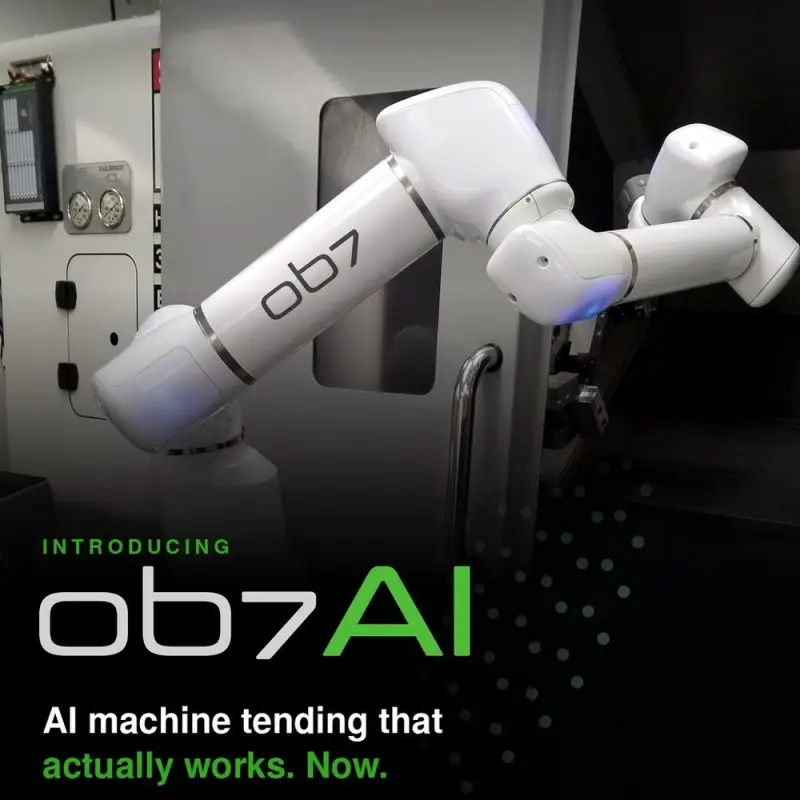
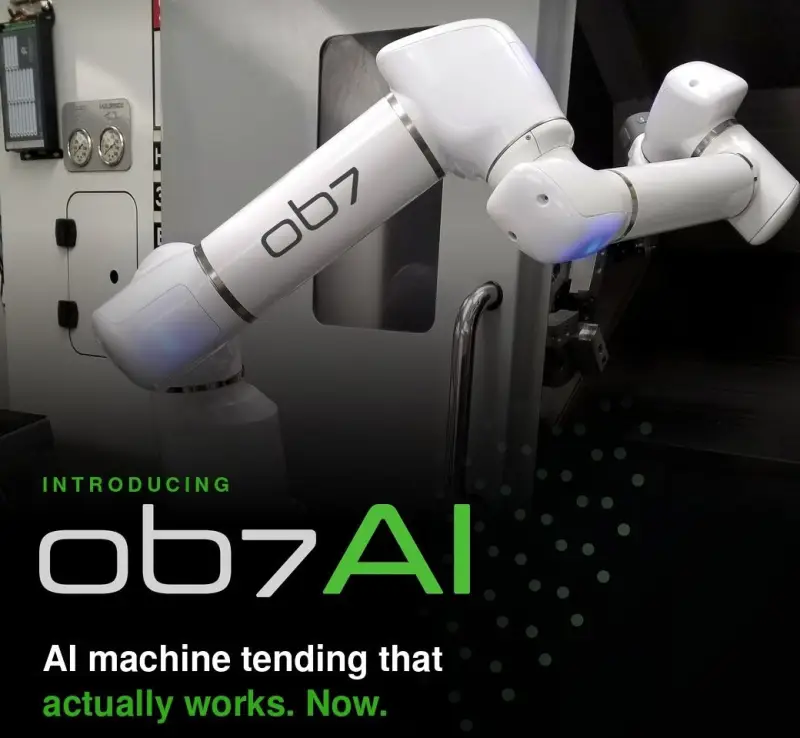
Productive Robotics says its new OB7AI cobot can take a recurring setup task out of CNC machine tending: teaching the robot how to approach each new job. Introduced at IMTS 2026, the seven-axis system scans the area around a mill, then uses that scan to locate the equipment and parts during its work cycle. The company says it requires no AI training cycles for new parts or tasks.
That claim matters most for job shops and contract manufacturers handling high-mix, low-volume work. Traditional automation can be difficult to justify when each short run brings another setup, and the time spent preparing a robot eats into the production time available. OB7AI is intended to reduce that preparation by moving from an operator guiding the arm for each job to a system that finds its way around the machine after an initial scan.
From touch teaching to a machine scan
Productive Robotics’ existing OB7 cobots are taught by touch: an operator guides the arm through a job with a control handle, without writing code. The company describes that method as simple, but it still takes operator time whenever a job needs to be taught. OB7AI changes that first step. When the robot is placed at a mill for the first time, it scans the work area and identifies where items are located.
After that scan, the operator stages blanks on a work table and presses “Work.” The blanks do not need precise placement, according to the company, provided there is enough finger room between them for the gripper to reach each one. OB7AI then locates a blank, opens the mill door, loads the part into the vise and closes the door. It presses the cycle start button and reads the CNC screen to determine when machining has finished. It then opens the door, unloads the finished part and repeats the sequence until the job is complete.
The stated setup is deliberately short: scan once per mill, stage parts, and start the work cycle. That sequence puts the scan at the centre of the system’s adaptation. The company says there are no AI training cycles for new parts or tasks; it does not provide technical details here about the sensing hardware, screen-reading method, supported CNC controls, gripper options or how the robot responds to unexpected changes in the work area.
Why setup time shapes the business case
For high-mix production, the relevant measure is not just how quickly a robot can load one part. It’s how much operator attention each changeover requires and how much unattended production time remains after setup. If a process requires lengthy programming or teaching for every new part, short runs can leave too little time for the automation to earn back that effort.
OB7AI’s proposed advantage is to reduce the repeated teaching step. Productive Robotics says the system can let operators recover the time spent guiding the existing OB7 through a job, while small jobs can run unattended. The company also describes the target as keeping mills productive around the clock. That is a stated application goal, rather than a measured utilization result: no production data, cycle-time comparison or uptime figures are supplied.
There are practical details a shop would need to evaluate before deployment. The source describes part staging, access for the gripper, mill-door operation, vise loading and CNC-screen reading, but does not specify machine compatibility, safety arrangements, supported part dimensions or the handling of exceptions such as a failed load or an interrupted machining cycle. Those details will determine how easily the approach fits a particular cell and how much supervision a job still needs.
A broader physical AI pitch
Productive Robotics presents OB7AI as a move from execution-based programming toward adaptive robot operation. President Zac Bogart said that teaching OB7 is straightforward and only needs to be performed once per job, but still consumes time. He said the new system scans and navigates around a job shop’s machines without requiring training cycles for new parts or tasks.
Bogart also identified automotive work and CNC machining as key markets for cobots with physical AI, and said the added capability could extend to laboratory research and healthcare. The system’s described workflow, however, is centred on CNC tending. The practical test for shops will be how reliably its scan supports the range of machine layouts, part batches and day-to-day changes they need to handle.
OB7AI’s central promise is specific: one scan of a mill, followed by automated loading and unloading without a new AI training cycle for each part. For shops where frequent changeovers constrain unattended machining, the useful measure will be the setup time and operator attention the system actually saves across real jobs.
 Choosing Single, Double, Welded Flap and Repair Keder for Fabrication
 Houston Engineering Team Builds a Welcoming Golf Tournament at East River 9
 MIG Transfer Modes: Choosing Between Short Circuit, Spray and Pulse