Productive Robotics’ 7-Axis OB7 Automates Gear Deburring with Force Control
Productive Robotics says its OB7 cobot doubled gear deburring throughput and cut scrap from 10% to 1% in its Carpinteria factory.
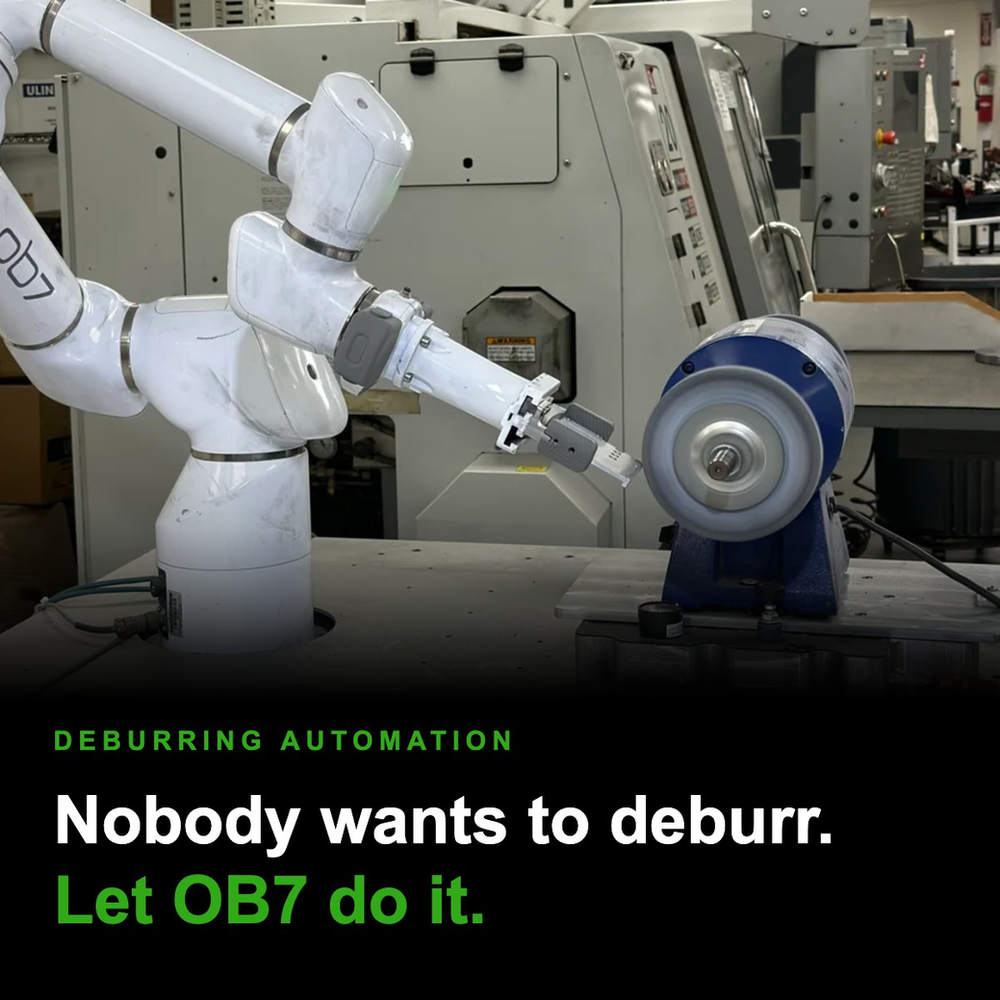
Deburring is often a bottleneck between CNC machining and a shippable part: it takes sustained manual attention, and the finish can vary with the operator and the point in the shift. Productive Robotics says its 7-axis OB7 cobot now handles gear deburring in the company’s Carpinteria, California, factory. The company reports that the change reduced scrap from 10% to 1% and doubled throughput compared with manual deburring.
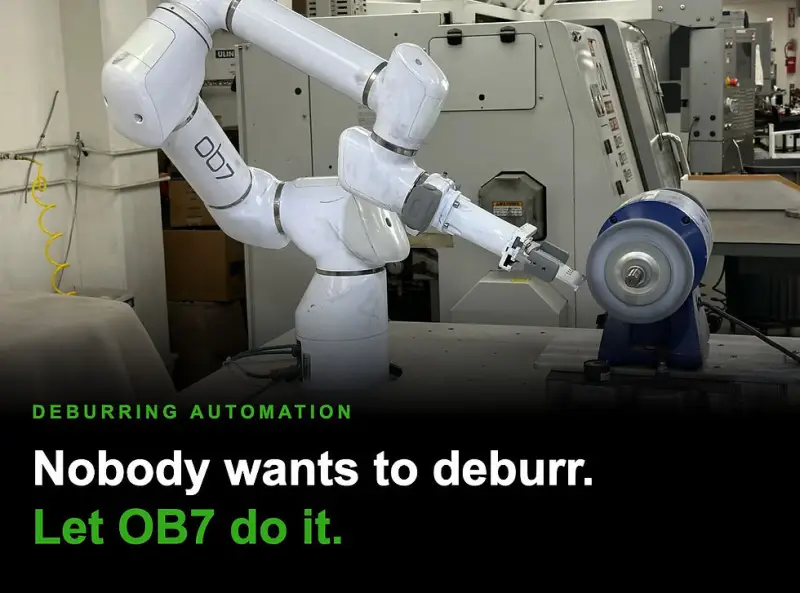
Those figures describe the manufacturer’s own production experience, rather than a general performance guarantee. The result will depend on the part, the taught motion and the process setup. Still, the reported comparison points to the practical case for automation: holding contact force and tool paths consistent can reduce variation while freeing an operator to take on other work.
Repeatable contact at the grinding wheel
The cell follows a straightforward sequence. OB7 picks a workpiece from a staging grid, guides its edges against a bench-grinder wheel, then places the part back in the grid. A programmed path sets the contact angles, while the deburring stage applies an adjustable constant force from 1.5 to 14.9 lb. The stage can compensate for up to 2" of wheel wear, according to Productive Robotics.
Force control matters because deburring quality depends on the interaction between the edge and the abrasive surface. If pressure changes from pass to pass, material removal and finish can vary. A consistent applied force gives the taught path a repeatable contact condition, though the manufacturer does not provide a universal cycle time or finish specification; it says those depend on the part.

The seventh joint is a notable part of the arrangement. It rotates ±540°, allowing the arm to turn round parts against the wheel so the edge can be worked around the circumference. For parts that need attention on both sides, a regrip station lets the robot set the workpiece down, pick it up again and continue on the other side.
Productive Robotics gives a cycle range of 30 seconds to a few minutes, depending on the workpiece. The cell can be loaded with 30, 40 or more parts for unattended batch processing. The company also says some customers run batches as small as five parts, a useful point for shops where short runs make dedicated automation harder to justify. The actual time saved will depend on how much handling and finishing the manual process currently requires.
Teaching by demonstration
OB7’s motion is taught by moving the arm through the required sequence by hand. The robot then stores those movements as a job. Productive Robotics says teaching a simple part takes about 10 minutes, and a saved job can be loaded again in minutes when that part returns to production.
This approach lowers the programming burden for a cell that may see different part geometries. Each job still needs a suitable taught path and setup: the robot has to reach the edges that require finishing, hold the part securely and bring it into contact with the wheel at the intended angles. The source provides no supported part-size or weight range, so those limits need to be checked for the specific application.
Package options and shop connections
The package includes the 7-axis OB7 arm, controller and tablet; a PG2 parallel programmable electric gripper; a force-controlled deburring stage that mounts most common bench-grinder motors; a 47" × 47" work table and robot stand; and a robot machine interface with its cables. Productive Robotics specifies standard 110V power and 60 PSI shop air.
The open-cell package occupies a 47" × 47" footprint, which the company describes as about 16 sq ft, and it estimates half a day to unpack and set up. An enclosed version adds containment intended to keep metal dust and debris inside the cell. That distinction gives shops a choice between an open work area and an enclosure around the deburring operation; the supplied details do not specify filtration performance or dust-control ratings.
Productive Robotics presents the system as a turnkey package that needs no special foundations or IT setup. It also says safety fencing isn’t required, but that statement should be read as a claim about this package, not as a substitute for assessing the complete installation. The grinder, workpiece, cell layout and surrounding operations all affect the safeguards a shop needs.
The strongest case for the OB7 is a recurring deburring task with a repeatable sequence, enough volume to keep a batch moving and edges the robot can reach with its gripper and wheel arrangement. The reported scrap and throughput results make the company’s own gear operation a useful example; for another shop, part geometry, wheel wear, cycle time and the effort needed to teach each job are the details that will determine whether the same approach fits.
 Choosing Single, Double, Welded Flap and Repair Keder for Fabrication
 Houston Engineering Team Builds a Welcoming Golf Tournament at East River 9
 MIG Transfer Modes: Choosing Between Short Circuit, Spray and Pulse