ISO 21423 Sets a Common Communication Framework for Industrial Mobile Robots
ISO 21423 builds on earlier AMR interoperability work, defining shared data and action requests across robots, fleet managers and facility systems.
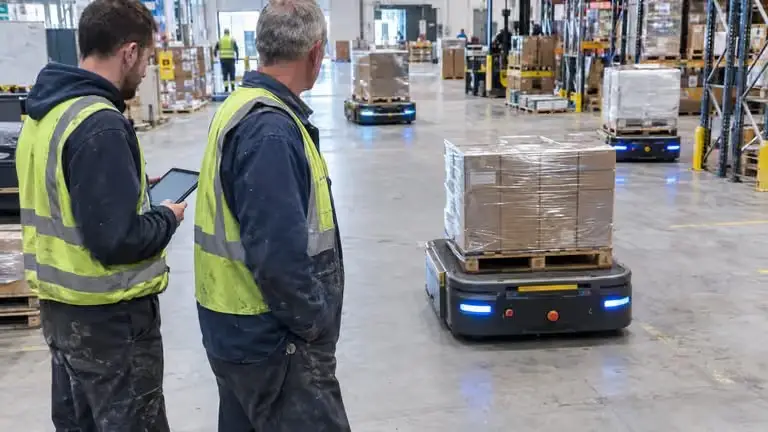
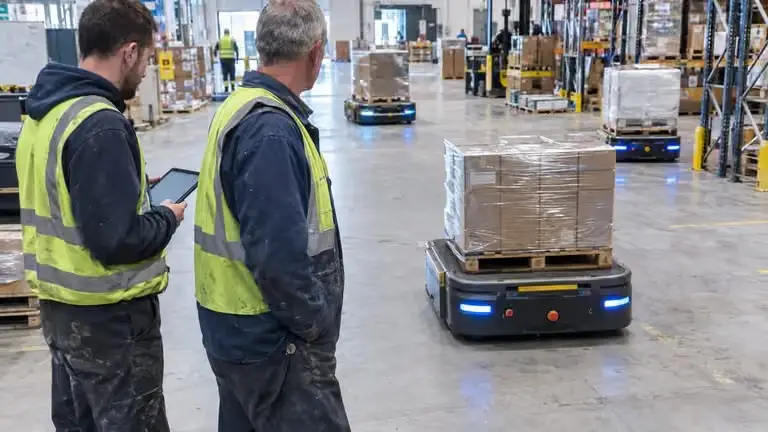
ISO 21423 gives industrial mobile robots from different vendors a common framework for exchanging information and requesting actions. Published in 2026, the standard extends beyond robot-to-robot data sharing to cover fleet managers and other equipment in shared industrial environments. Its practical promise is simpler coordination across a mixed fleet, where one supplier’s robot may be well suited to a task that another supplier’s machine cannot handle.
The framework grew from a problem encountered by warehouse and factory operators: they were evaluating robots from multiple vendors, but each system brought its own integration demands. The resulting work started in 2020, when MassRobotics convened its AMR Interoperability Working Group. Participants set out to make it easier for autonomous mobile robots (AMRs) from different suppliers to operate in the same facility.
A deliberately small first step
The group’s initial scope focused on information that robots need to share to coordinate movement and communicate their operational state. That included location, speed, direction, health and availability. Keeping the first specification focused was intended to make implementation practical for vendors and useful to operators already managing equipment from more than one supplier.
Robot developers and end users took part in the group. Contributors included Vecna Robotics, 6 River Systems, Waypoint Robotics, Locus Robotics, Seegrid, MiR, Autoguide Mobile Robots, Third Wave Automation, A3 and Open Robotics. FedEx, Procter & Gamble and DHL were among the end users who helped establish the need. They were already testing robots from several vendors, and no single provider could cover every task.
MassRobotics published the first version in 2021 as an open-source interoperability standard. The specification was made freely available through GitHub. Its first trial took place at a FedEx facility, where AMRs from Waypoint Robotics, Vecna Robotics and other suppliers operated in the same space. That test put the core challenge in concrete terms: robots need enough shared information to account for one another as they move through a facility.
The early work established a common starting point, but a specification alone doesn’t make a mixed fleet coordinate well. Each system still has to implement the relevant exchanges, and the facility’s equipment and operating processes have to fit the interface. A shared data format can reduce the burden of bespoke connections; it does not, by itself, decide which robot should perform a task or how a site should manage traffic.
From working group to international scope
ISO 21423 was developed by ISO Technical Committee 299, Working Group 10. It builds on two frameworks: the MassRobotics Interoperability Standard, piloted in North America, and VDA 5050, widely adopted in Europe. Members of Germany’s VDMA helped align the approaches as the working group expanded to nearly 90 participants from more than a dozen countries.
The resulting standard describes how mobile robots, fleet managers and other equipment can exchange information and request actions. Robot data includes location, speed, direction, condition, tasking and availability. Those fields preserve the original focus on coordinating the machines’ movements and status, while the broader scope adds communication with lifts, automated doors, alarms, enterprise resource planning (ERP) systems and workers carrying mobile devices.
That wider scope matters because a robot’s route and task can depend on equipment outside its own fleet. A lift or automated door may need to respond to a robot’s request; a fleet manager may need to account for conditions elsewhere in the facility. Connecting these systems through a shared framework gives integrators a defined basis for those exchanges. The standard describes communication requirements, while individual installations will still depend on the systems and functions a site chooses to connect.
ISO 21423 uses MQTT and JSON, technologies already used by companies implementing the MassRobotics standard. That existing work gives those companies a starting point for alignment with the international specification. It doesn’t mean every installation will be compliant automatically: teams will need to check their implementations against the standard and the equipment they intend to connect.
What operators can expect
For facility operators, the intended gains are operational. Better information sharing can help reduce situations where robots block one another, cut the need for people to intervene to clear jams and improve robot availability. A shared framework could also make it easier to select a robot for a particular job without building another custom integration for every vendor pairing.
Those results depend on adoption across the equipment in a facility. The value increases when robot suppliers, fleet management systems and relevant facility equipment can exchange the information and requests the standard defines. Operators evaluating a mixed fleet can use the specification as a common reference point when assessing integration needs; they’ll still need to confirm how a vendor’s implementation supports their specific equipment and workflows.
A3 announced the publication of ISO 21423, which it described as the first non-safety robot standard it had helped produce. The next measure of the work will be how widely suppliers and operators put it into practice. The standard provides a common communication basis; adoption will determine whether that basis reduces the integration work involved in running mixed fleets on shared floors.
 Choosing Single, Double, Welded Flap and Repair Keder for Fabrication
 Houston Engineering Team Builds a Welcoming Golf Tournament at East River 9
 MIG Transfer Modes: Choosing Between Short Circuit, Spray and Pulse